

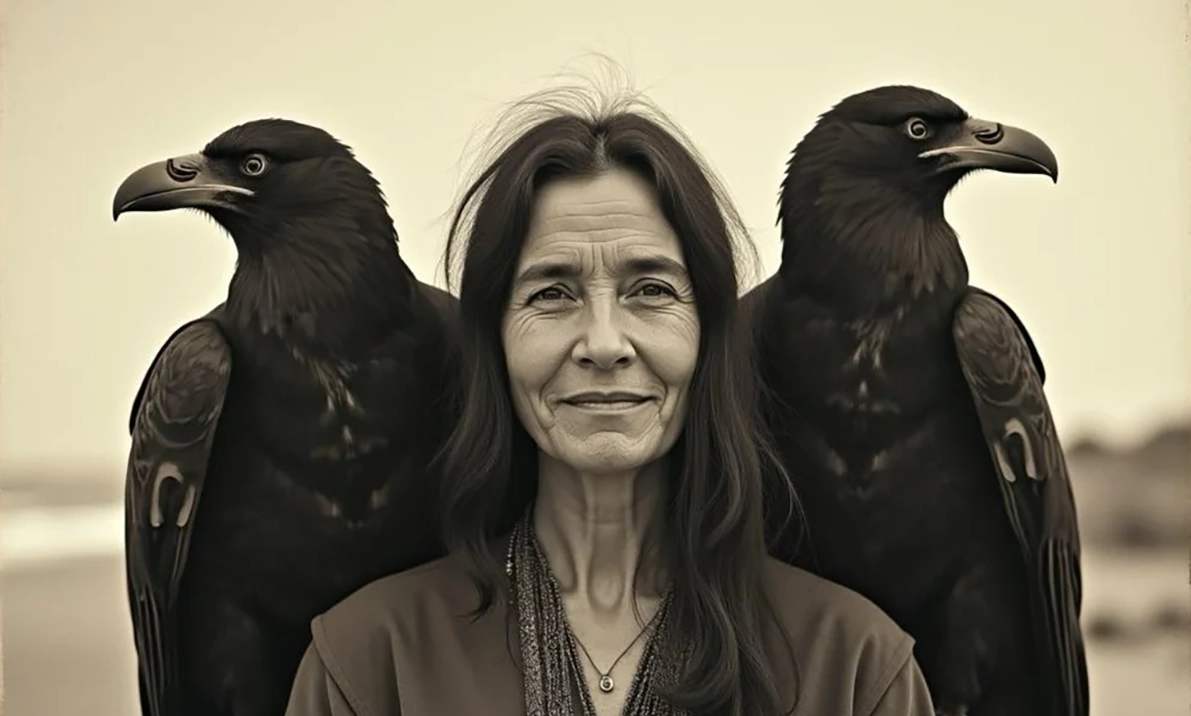
Camille Ross is an American photographer and visual artist whose practice is deeply informed by ancestry, cultural contrast, and the search for personal identity. Born in San Francisco in 1964, Ross grew up between two distinctly different environments: the politically progressive culture of Berkeley during the 1970s and the rural landscape of Mississippi. Experiencing these contrasting worlds shaped her awareness of race, community, history, and belonging from an early age.
Her biracial background and Cherokee heritage now occupy an important place within her creative work. Through photography and digital image-making, Ross examines how ancestral knowledge can survive across time, even when family histories have been disrupted or partially forgotten. Her compositions are filled with symbolic roads, powerful birds, spiritual guides, and dreamlike figures. Together, they suggest that ancestry is not simply a record of the past, but a presence that continues to influence the imagination and guide the living.
Mapping a Journey Across Generations
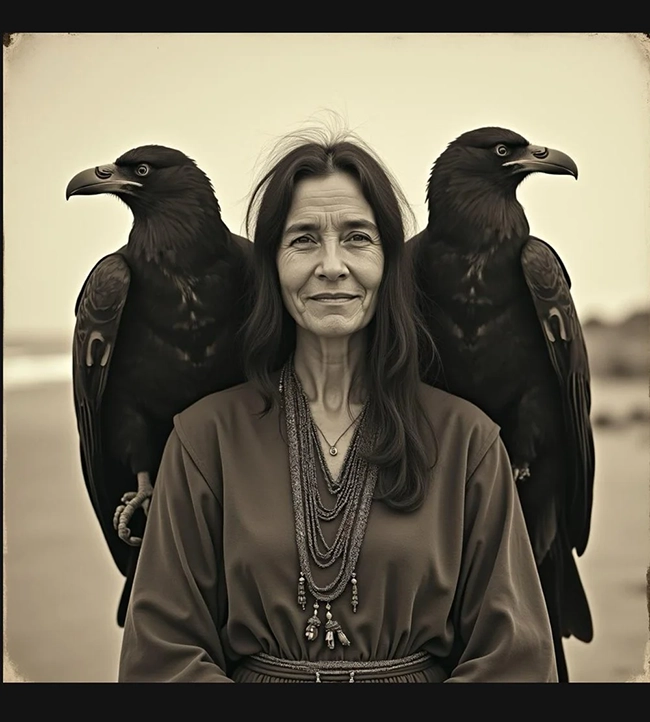
Ross’s series was created as a personal tribute to the ancestors whose lives and movements made her own existence possible. Rather than presenting their history as a straightforward chronology, she approaches it as an expansive passage across landscapes, cultures, and generations.
The journey begins in Mongolia and moves toward Siberia, across the strait to Alaska, and onward through coastal communities, the Great Plains, Oklahoma, and the Cherokee Nation. These locations become part of a symbolic ancestral map. Each one carries associations with migration, displacement, survival, and the determination to continue despite profound hardship.
Ross traces part of this history to ancestors who traveled from Siberia to Alaska before joining a small coastal fishing tribe. Within the traditions she explores, the raven was admired for its intelligence and regarded as a source of guidance and healing. It could lead travelers through uncertainty and help them rediscover the way home. This understanding gives the raven a central role in Ross’s imagery.
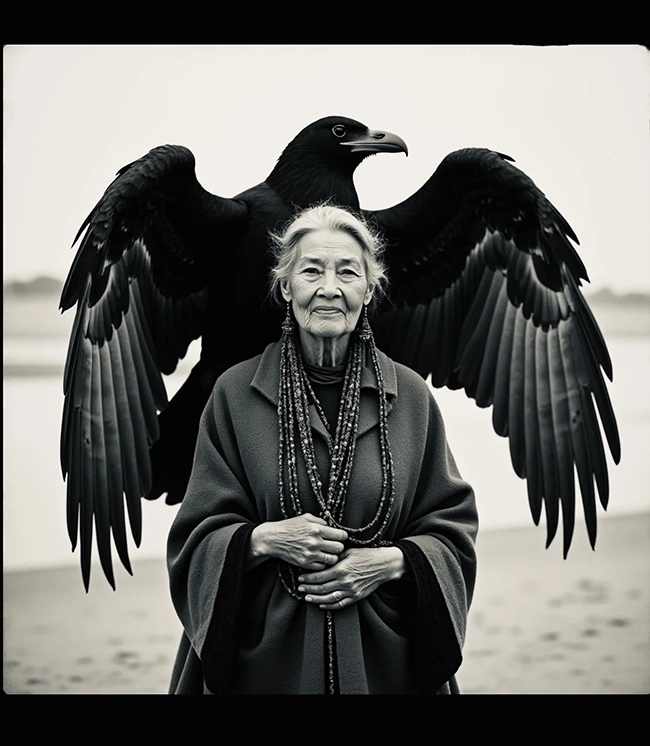
The bird becomes more than a recognizable creature from the natural world. It acts as a companion, witness, and intermediary between different realms. Moving between the earth and sky, the raven is well suited to Ross’s visual language, which frequently shifts between physical history and spiritual possibility.
Her investigation of family lineage also led her to the Great Plains, where she says she discovered a relative associated with the Lakota Sioux Reservation who fought at Wounded Knee. From there, the ancestral route continues into Oklahoma, once widely referred to as “Indian Country,” and to the Cherokee Nation.
This part of the family story carries considerable pain. Ross identifies her great-grandmother, her great-grandmother’s siblings, and their parents as Cherokee slaves. Their experiences form part of a difficult history that cannot be completely recovered through conventional family records. Ross does not attempt to reconstruct every missing detail. Instead, she creates images that acknowledge the lives, struggles, and resilience of those who came before her.
Her great-grandmother later became the mother of two daughters, Ojanna and Oleta. Ojanna, Ross’s grandmother, was born during the early twentieth century and died before Ross could meet her. This absence gives the work an additional emotional dimension. Through art, Ross imagines a connection with a family member she knows through inheritance, stories, and intuition rather than direct experience.
Image-making consequently becomes an act of remembrance. It allows Ross to approach the distance between herself and previous generations while creating a symbolic place in which that separation can briefly dissolve.
Birds as Protectors and Messengers
Ravens, eagles, and hawks appear throughout Ross’s visual world as symbols of intelligence, protection, movement, and spiritual communication. Their presence reflects cultural associations, but it is also tied closely to the artist’s dreams.
Ross explains that much of the recent series developed from an intense dream involving her ancestors. In the dream, she walked along an extended red road that carried her away from the city. As she continued, an enormous red-tailed hawk descended and settled on her shoulder. The bird was powerful and beautiful, yet its presence felt protective rather than threatening. It later transformed into a Native American chief.
The encounter left Ross with a strong visual impression and became the foundation for several of the hybrid spiritual beings in the series. She relates these figures to religious traditions in which sacred beings combine human and animal characteristics. Her own compositions feature birds resting beside female shamans, healers, and falconers, suggesting a relationship based on trust, guardianship, and shared knowledge.
Within this symbolic vocabulary, the red road can be understood as a path leading away from the noise of contemporary life and toward a deeper recognition of ancestry. The hawk’s transformation strengthens the sense that the journey is both internal and spiritual. What begins as movement through a landscape becomes an encounter with inherited wisdom.
Ross has long felt protected by the ancestors who preceded her. The dream gave that belief a visible shape, allowing her to represent guidance as a physical presence accompanying the traveler.
Transforming Inner Visions Into Images
Although Ross’s artistic foundation is photography, she has expanded her process through contemporary digital methods, including artificial intelligence. These tools allow her to construct scenes that would be challenging, or perhaps impossible, to stage through traditional photography.
Technology, however, is not the true subject of the series. It serves as a means of translating experiences that begin elsewhere: in family history, dreams, memory, research, and intuition. The emotional direction remains Ross’s own, while the digital process helps her visualize worlds that previously existed only within her imagination.
Her finished compositions move between photography, symbolic portraiture, mythology, and digital collage. They are not intended to be literal reconstructions of historical events. Instead, they offer personal interpretations of stories that have survived only in fragments.
This distinction is essential to understanding the work. Ross is not claiming that an image can replace a lost archive or recover every detail of an ancestor’s life. She uses art to respond to what remains incomplete. Where documentation ends, visual imagination creates another way of engaging with the past.
Throughout the series, roads stretch toward unknown destinations, birds hover as protectors, and spiritual figures inhabit spaces between reality and dreams. These elements create a visual world in which migration becomes both a historical experience and an inward journey.
Ross’s work ultimately considers how people carry histories they did not witness themselves. Her images honor ancestors who endured displacement, hardship, and cultural change while preserving a sense of connection across generations.
By bringing ancestral memory together with contemporary image-making, Ross creates a meeting place between the distant past and the present. The technology may belong to the modern world, but the desire at the heart of the series is timeless: to understand one’s origins, acknowledge those who came before, and follow the signs that lead home.
