

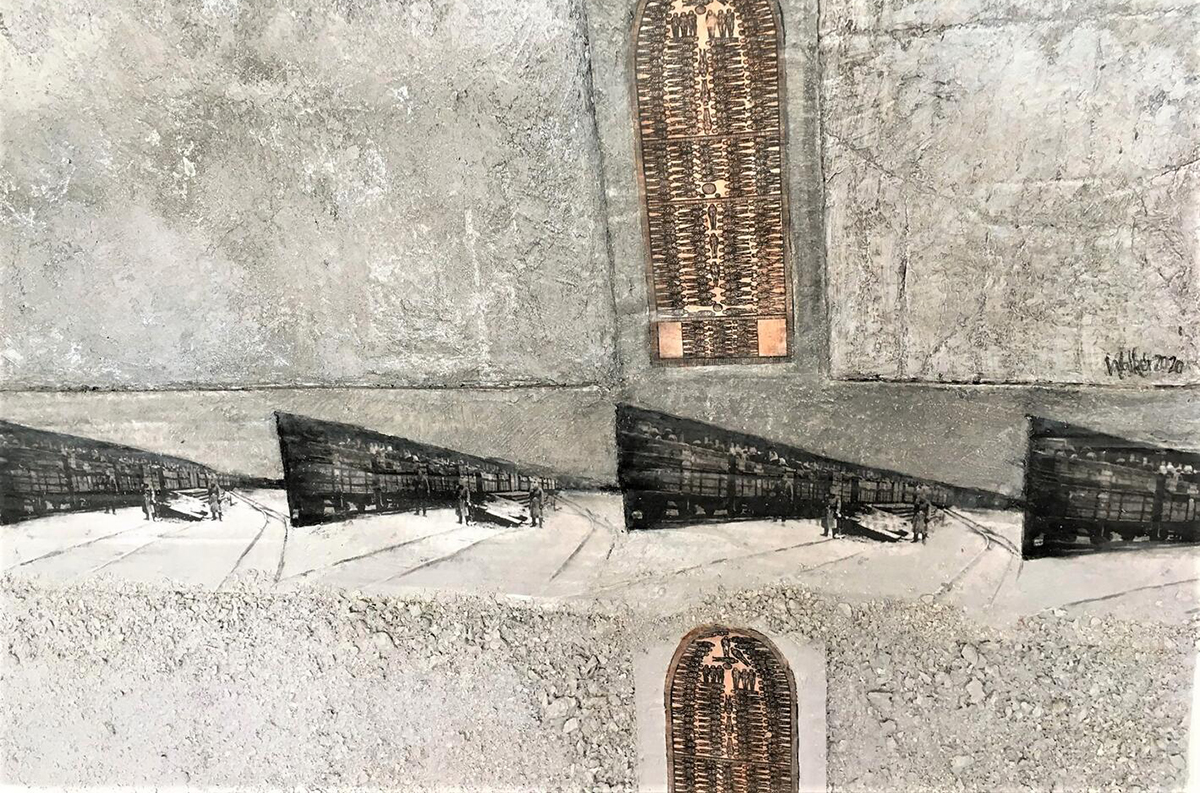
In Ancestors Transported, artist Barbara Walker confronts two devastating histories that converge within her own family: the enslavement of her Jamaican ancestors from West Africa and the murder of her German Jewish grandparents during the Shoah. Created in 2021 using mixed media on cardboard, the work transforms personal remembrance into a broader reflection on persecution, displacement, and the systematic devaluation of human life. Walker does not attempt to equate these distinct atrocities. Instead, she brings them into a shared visual space, acknowledging how both histories continue to shape her identity and understanding of the past. Through repeated images of transportation, confined human figures, distressed surfaces, and an inverted cross, Ancestors Transported becomes an act of mourning and testimony. It asks viewers to remember the individuals who were forcibly removed from their homes, stripped of their dignity, and transported under horrific conditions toward enslavement or death.
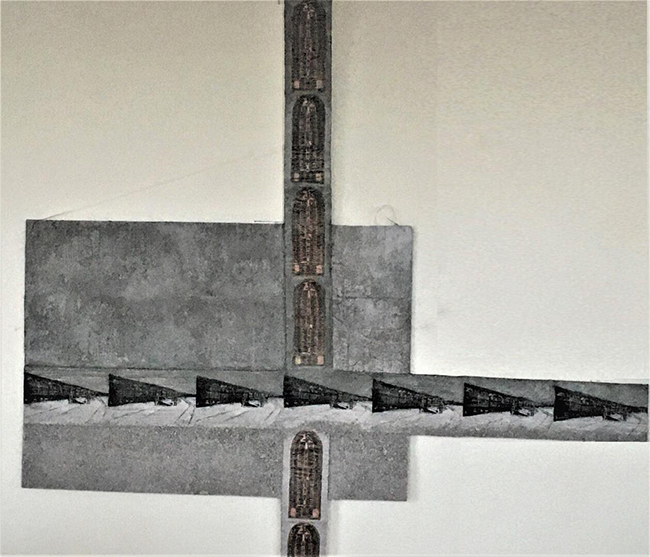
The composition is built around a powerful cross-like structure. Horizontal and vertical passages intersect across the cardboard surface, creating a visual framework that initially suggests order but gradually reveals rupture and violence. The cross is inverted, expressing Walker’s criticism of what she sees as the Church’s complicity in both histories. Rather than functioning as a conventional symbol of comfort or salvation, it becomes unsettled and accusatory. Its reversal encourages the viewer to consider how religious institutions and beliefs can be distorted when aligned with systems of power, racial hierarchy, persecution, or silence.
The work’s materials contribute significantly to its meaning. Cardboard is ordinary, fragile, and easily discarded. Unlike marble, bronze, or another traditionally permanent material, it carries associations with packaging, shipping, storage, and transportation. Its use is particularly resonant in a work concerned with human beings treated as cargo. The surface appears worn and layered, as though it has absorbed the damage of movement and time. Its vulnerability mirrors the physical vulnerability of those who were transported against their will, while its survival as an artwork suggests the endurance of memory.
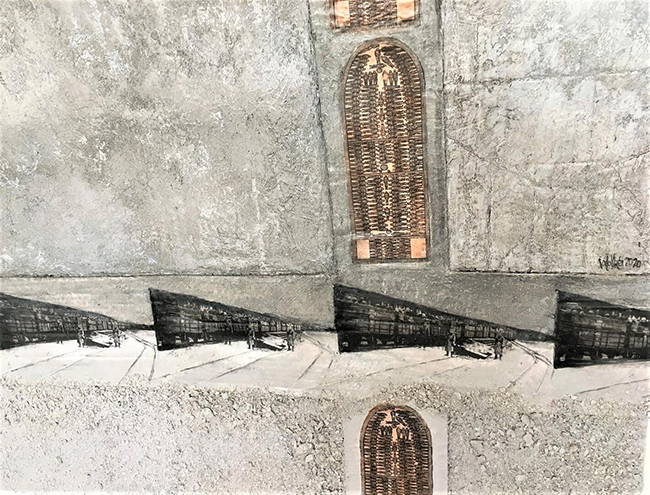
Across the horizontal section, Walker repeats dark, angular images resembling ships, railway cars, industrial structures, or transport vessels. Their exact identity remains deliberately unsettled. They can evoke the ships used in the transatlantic slave trade as well as the trains associated with the deportation of Jewish people during the Holocaust. Repetition creates a relentless rhythm, suggesting that forced transportation was not an isolated occurrence but an organized process carried out on an enormous scale.
These repeated forms move across the picture plane like a grim procession. Their sharp silhouettes interrupt the pale ground and establish a severe contrast between darkness and light. Although the work contains no conventional portrait, the human presence is unmistakable. Small figures and densely packed linear marks suggest bodies confined within narrow spaces. Individual identities become difficult to distinguish, reflecting how oppressive systems reduced people to numbers, labor, racial categories, or anonymous groups.
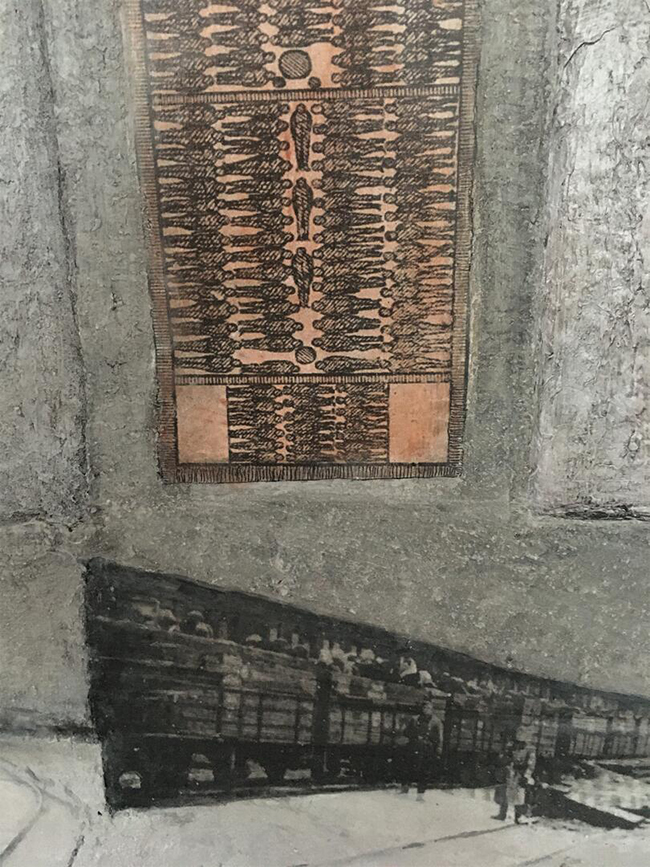
In the vertical portions of the composition, Walker includes elongated, coffin-like forms filled with tightly arranged figures. The close spacing creates a sense of compression and confinement. Viewed from a distance, these forms may resemble architectural windows or memorial panels. Up close, however, their interiors reveal human shapes surrounded by dense markings. This tension between monument and enclosure is central to the work. The forms preserve the memory of the dead while also suggesting the spaces in which people were imprisoned and transported.
Walker’s restrained palette reinforces the atmosphere of mourning. Gray, black, off-white, and muted brown dominate the work, producing a surface that feels aged, archival, and almost ashen. The absence of vivid color prevents visual beauty from softening the subject. Instead, attention is directed toward texture, structure, and symbolic detail. Rough passages resemble damaged walls, weathered documents, or landscapes marked by historical trauma.
Yet Ancestors Transported is not simply an image of despair. Its creation is itself a form of resistance against erasure. By connecting historical violence to her own ancestry, Walker restores a human and familial dimension to events often encountered through statistics. The victims are not distant abstractions. They are grandparents, ancestors, and individuals whose interrupted lives remain present within later generations.
The work also raises difficult questions about inherited memory. How does a person carry histories that occurred before their birth? How can art address two different atrocities without diminishing the distinct reality of either one? Walker responds through remembrance rather than explanation. She allows the histories to exist beside one another, connected through her family but preserved in their specific emotional weight.
Ultimately, Ancestors Transported is a memorial made from vulnerable materials and unresolved forms. It invites sustained looking while refusing easy consolation. Through its inverted cross, repeated vessels, confined figures, and scarred surfaces, the work confronts the structures that made mass suffering possible. At the same time, it insists that those who were displaced and murdered must not disappear into silence. Walker’s act of remembrance transforms private ancestry into a solemn public reflection on human value, responsibility, and the continuing necessity of bearing witness.
