

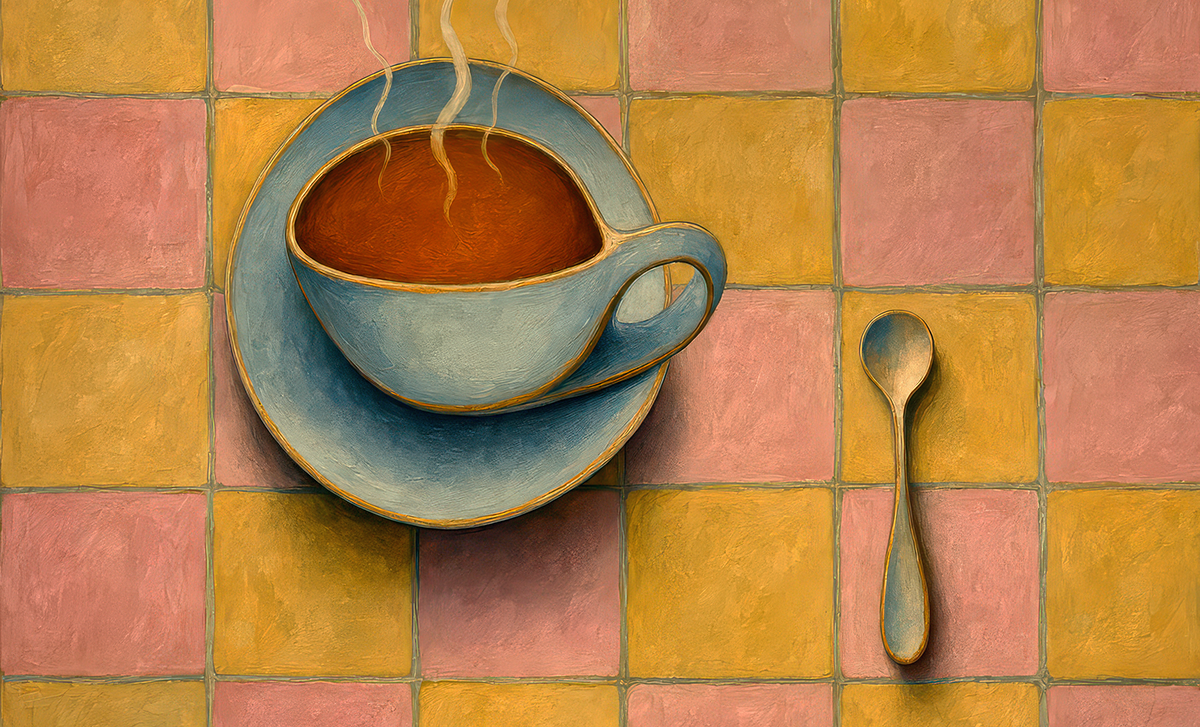
Alan Brown first encountered the possibilities of image-making in a darkroom. Under its red light, a photograph emerged gradually from what had appeared to be a blank sheet. The experience asked for patience: an image could not be hurried into view, and each stage changed what could be seen. That early encounter stayed with Brown because it offered more than a way to make pictures. It showed him how an ordinary subject might become unfamiliar when placed in a new setting or seen from another angle. In Teatime, Brown brings that curiosity to a modest domestic moment. A cup of tea provides a point of recognition, but the space around it refuses to behave as expected. Tilting tiles and overlapping viewpoints draw the eye away from any single, settled account of the scene. What begins with a familiar ritual opens into a playful question about how we see.
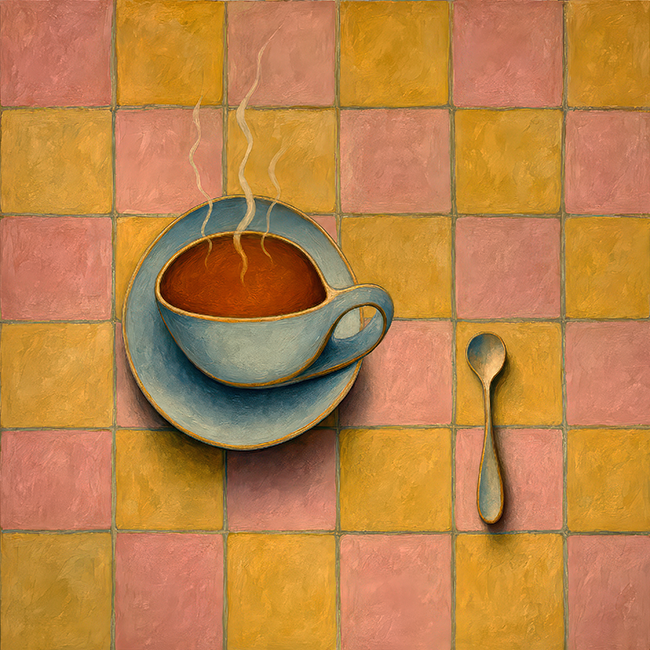
A cup of tea usually invites a pause. It suggests a table, a chair, perhaps a few minutes taken between other parts of the day. Brown keeps that quiet association in Teatime, then changes the space in which it might unfold. The cup belongs to an everyday setting, yet the tiles seem to tilt and the room appears to fold around it. We recognize what we are looking at without being able to place ourselves comfortably within it.
That uncertainty gives the work its movement. The eye may begin with the cup, searching for a stable point, then follow the angles of the tiles into another part of the composition. Just when one view starts to make sense, another interrupts it. Brown allows several ways of seeing to coexist. The result feels less like looking into a room from a fixed position than moving around it and remembering those glimpses all at once.
The shifting perspective also changes the pace of looking. In a conventional depiction of a cup on a table, the relationship between objects is quickly understood. Here, the viewer has to keep adjusting. A line that appears to establish one plane may lead toward another. Color and shape become as compelling as the subject itself. The cup still matters, but it no longer carries the entire picture; the surrounding space takes an active role.
There is humor in giving a small domestic ritual this much visual freedom. Tea is often associated with routine, with doing something in the same way each day. Brown treats that routine as a starting point for invention. The scene seems to ask what might happen if we paid closer attention to a moment we ordinarily pass through without a second thought. Its strangeness grows from something we already know.
The title, Teatime, adds to that effect. It names a familiar part of the day and offers a simple expectation: someone might sit down, lift the cup, and drink. Yet the picture does not depend on showing that action. Instead, it stretches the moment before or around it. The tilted tiles and folded space can make a few quiet minutes feel expansive, as though thought or imagination has altered the room.
Brown’s approach leaves room for more than one reading. The unsettled perspective might recall a dream, when a place feels recognizable even though its proportions change without warning. It might also suggest the way memory works: we do not always retain a scene from one exact viewpoint. We remember a color, an object, a corner of a room, and the feeling of being there. Those pieces can come together in ways that are vivid without being orderly.
The work does not require an explanation for its unusual space. Part of its pleasure lies in following the composition without trying to straighten it. The cup offers an anchor, while the surrounding shapes keep the experience open. Viewers can return to it and find their attention caught by a different angle or relationship each time.
In Teatime, Brown makes an everyday subject feel newly available to the imagination. A cup remains a cup, and a tiled setting remains partly recognizable. But as viewpoints shift, certainty gives way to curiosity. The scene invites us to linger in that change, discovering how much can happen within a moment that first appeared entirely ordinary.
