

For Keith McHugh, artistic expression begins where language, emotion, and imagination intersect. His creative practice explores the intricate relationship between the conscious mind and the deeper currents of human experience, revealing how memories, feelings, and spiritual awareness shape our understanding of existence. Rather than limiting himself to conventional representations, McHugh embraces an intuitive approach that allows personal discoveries to emerge through imagery, symbolism, and poetic reflection. His compositions invite viewers to venture beyond appearances and consider the invisible forces that influence identity, perception, and emotional connection. Each artistic creation becomes an exploration of vulnerability, transformation, and the ongoing search for meaning. Through the interplay of visual storytelling and written expression, McHugh examines the delicate balance between uncertainty and understanding. His work suggests that creativity is not merely an act of making something visible, but a continuous process of discovering what lies within the human spirit.
Thought Streams From the River of Life: Where Imagination Becomes a Living Current
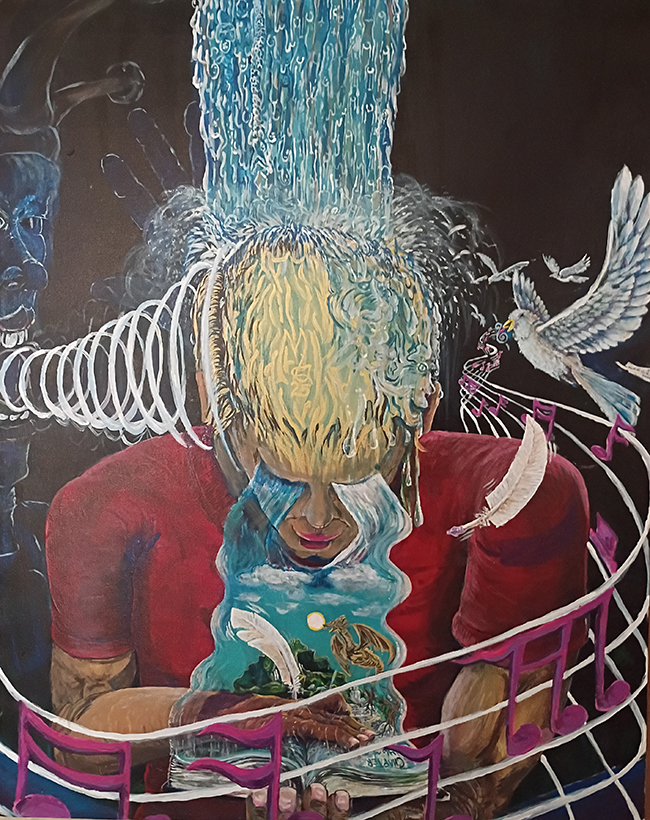
In Thought Streams From the River of Life, Keith McHugh presents a richly layered meditation on creativity, consciousness, and the passage of time. Combining an elaborate visual composition with an introspective poem, the artist transforms the experience of writing into a metaphor for existence itself. The artwork captures the extraordinary movement of thoughts as they emerge from the mind, travel through emotion, and eventually become expressions of personal understanding.
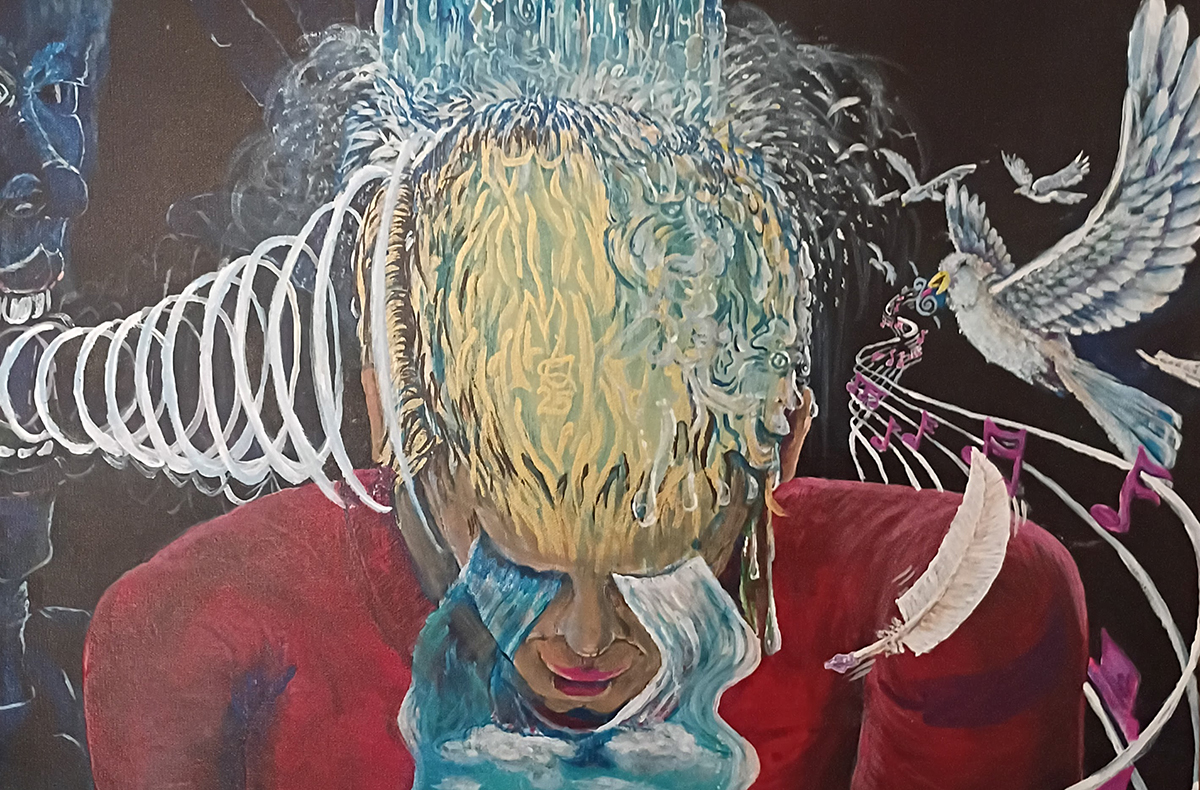
At the center of the composition, a figure dressed in red bends forward, seemingly absorbed in an intimate creative process. The figure’s head is surrounded by flowing forms, intricate textures, and streams of luminous blue and golden tones. These elements suggest an active internal world, where ideas continuously develop and transform. The downward posture conveys concentration and introspection, emphasizing the deeply personal nature of artistic creation.
One of the composition’s most striking features is the vertical cascade of blue forms descending toward the figure’s head. Resembling a waterfall, this stream establishes a powerful connection between the physical imagery and the artwork’s title. Water becomes a symbol of consciousness, representing the uninterrupted movement of thoughts, experiences, and emotions. Its descending motion suggests that inspiration arrives through a mysterious process, emerging from sources that cannot always be consciously explained.
The golden textures surrounding the figure’s head introduce another dimension to this symbolic narrative. Their organic, almost flame-like appearance creates a sense of mental energy and transformation. The interaction between blue and gold suggests a meeting between intuition and awareness, where abstract impressions gradually acquire recognizable meaning. McHugh presents the mind not as a fixed structure but as a constantly evolving environment shaped by imagination and experience.
Across the foreground, sweeping white lines and vibrant pink musical notes establish a rhythmic movement that carries the viewer’s attention throughout the composition. These elements introduce the possibility that thought possesses its own musical language. Just as melodies unfold through sequences of sound, ideas develop through associations, emotional responses, and unexpected connections. The musical imagery transforms the act of thinking into something fluid, spontaneous, and expressive.
A bird in flight occupies the upper-right portion of the painting, introducing a contrasting sensation of freedom and expansion. Its outstretched wings suggest the liberation of ideas beyond the boundaries of the individual mind. Nearby feathers reinforce this association, evoking lightness, movement, and the fragile beauty of inspiration. Together, these details create a visual dialogue between internal reflection and outward expression.
The poem accompanying the artwork deepens this exploration by describing the moment when creative energy begins to take shape. McHugh portrays writing as an instinctive encounter between thought and action, where the movement of the hand becomes inseparable from the movement of the mind. The image of ink dancing across paper suggests that creativity possesses a vitality of its own, developing organically rather than following a predetermined direction.
Throughout the poem, the river serves as an expansive metaphor for human existence. Its continuous movement reflects the changing nature of personal experience, reminding readers that growth often occurs without certainty about what lies ahead. The artist acknowledges this unpredictability while embracing the possibilities it creates. Instead of presenting uncertainty as something to overcome, he recognizes it as an essential condition of discovery.
Particularly meaningful is the poem’s emphasis on the present moment. McHugh considers the significance of “NOW,” suggesting that genuine awareness emerges when individuals become attentive to their immediate experiences. Although life continues moving forward, each passing instant contains the potential for understanding, creativity, and emotional connection. The present becomes both temporary and enduring, leaving impressions that remain long after the moment has passed.
This relationship between impermanence and memory gives the artwork its philosophical depth. The river never stops flowing, yet the creative act allows fleeting experiences to acquire a lasting form. Through painting and poetry, thoughts that might otherwise disappear become tangible records of consciousness.
Ultimately, Thought Streams From the River of Life celebrates the mysterious relationship between imagination and existence. McHugh’s combination of symbolic imagery, expressive color, and poetic language creates an immersive reflection on how human beings process their inner worlds. His work encourages viewers to recognize creativity as an ongoing journey rather than a final destination, revealing how even the smallest moments of awareness can become meaningful expressions of life itself.
