

Introduction: The Artist and Her Creative World
Born in 1949 and raised in California’s Bay Area, Deborah K. Tash is a painter and poet whose creative practice draws upon cultural heritage, personal reflection, and the natural world. Her artistic identity is closely connected to her Mexican maternal ancestry and Celtic paternal roots. Identifying as Mestiza, Tash explores the relationship between these traditions through imagery that embraces mythology, spirituality, and the interconnectedness of living things.
Her paintings and poetry offer different ways of expressing experiences that cannot always be explained through ordinary language. Rather than treating cultural influences as separate histories, she brings them together within imaginative compositions filled with symbolism and emotional depth. Nature frequently becomes a setting for transformation, where familiar creatures and landscapes take on unexpected meanings. Through her creative practice, Tash invites viewers to consider memory, belonging, loss, and renewal while discovering connections between the physical world and the mysteries of human experience.
Illuminated Poems Series / Raining And Mountain Leaping
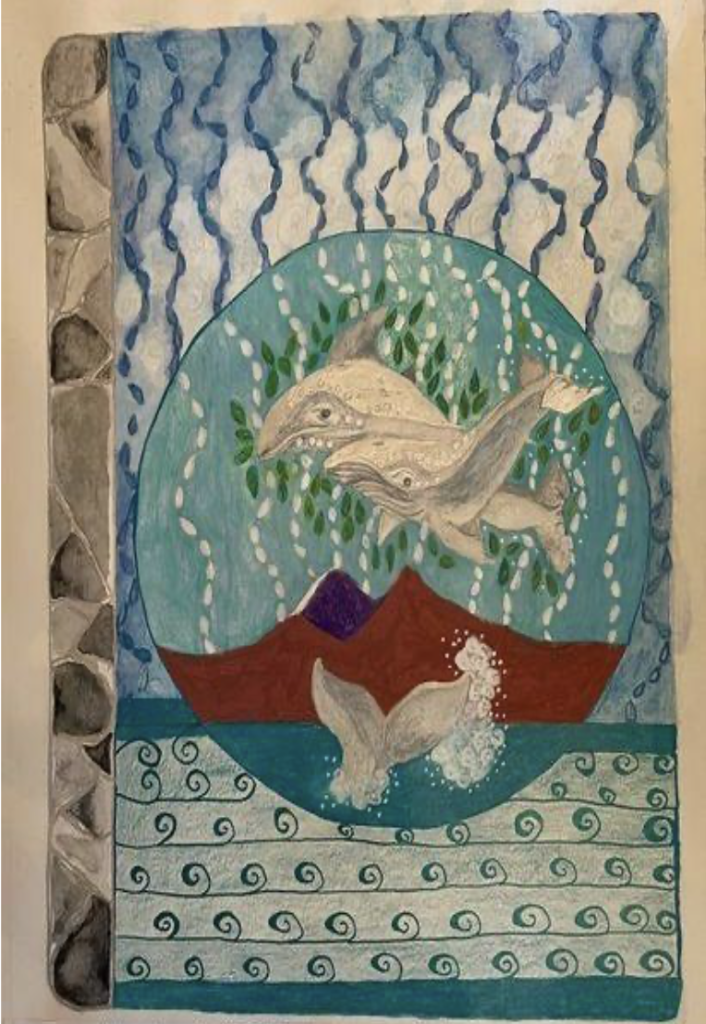
In Illuminated Poems Series / Raining And Mountain Leaping, Deborah K. Tash creates an imaginative underwater and mountainous landscape where whales appear to move effortlessly between ocean and sky. Executed in mixed media on paper, the painting brings together playful imagery, decorative patterns, and natural elements within a carefully organized composition. The scene presents a world where the usual boundaries of nature no longer apply, allowing marine creatures to leap above mountains while rain and foliage surround their movements.
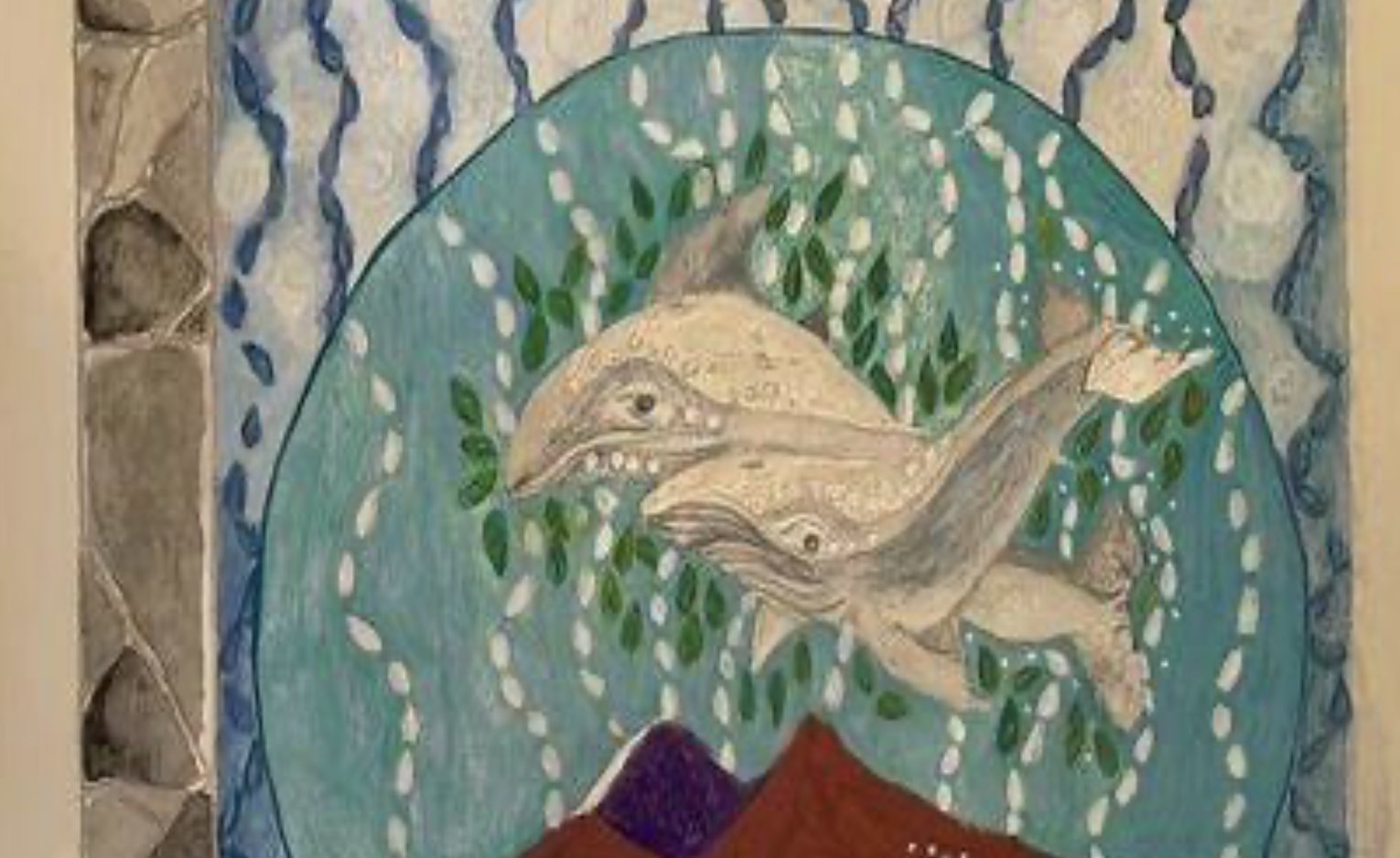
At the center of the composition, two whales swim together inside a large turquoise circular form. Their elongated bodies curve gracefully through the surrounding space, suggesting movement, companionship, and freedom. The whales appear suspended between different environments, neither entirely underwater nor completely airborne. Their pale coloring contrasts with the deeper turquoise background, giving their forms a gentle presence. Their expressions and flowing contours introduce a sense of warmth and curiosity, making them appear almost like characters from an illustrated folktale.
Behind the whales, clusters of green leaves rise through the circular space, accompanied by scattered white markings resembling falling rain. These botanical details create an environment that feels alive with movement. The leaves suggest growth and regeneration, while the descending droplets establish a visual rhythm throughout the composition. Together, these elements create an atmosphere in which water, vegetation, and animal life exist in an interconnected relationship.
Above the central circle, irregular blue lines descend across a pale background. Their winding shapes resemble streams of rain, flowing water, or twisting vines. Rather than depicting rainfall realistically, Tash transforms it into an expressive pattern that contributes to the painting’s dreamlike character. The repeated lines also guide the viewer’s attention downward, connecting the upper portion of the artwork with the whales and mountainous landscape below.
A reddish mountain range stretches across the lower section of the circular composition. Its angular peaks provide a contrasting structure against the rounded bodies of the whales and the curved boundary surrounding them. One mountain peak appears in a deep purple tone, introducing another variation in color. The mountains establish an earthly presence within an otherwise fluid environment, creating a meeting point between solid land and moving water.
Beneath the mountains, another whale is suggested through its raised tail as it dives into the ocean. A cluster of white bubbles rises from the water, capturing the moment of its disappearance beneath the surface. This detail introduces a different kind of movement from the two whales above. While the upper creatures appear to float through an imaginary space, the diving whale reconnects the composition with the familiar behavior of marine life.
The ocean occupies the bottom portion of the painting, represented through horizontal bands filled with repeating spiral patterns. These decorative waves suggest the continuous motion of water without relying on conventional realism. Their rhythmic arrangement recalls ornamental designs found in illustrated manuscripts and traditional storytelling imagery. The repetition creates a visual foundation that balances the more freely moving forms in the upper sections.
Along the left edge, Tash incorporates a vertical border resembling stacked stones. Its muted gray and brown tones contrast with the brighter colors elsewhere in the painting. The stone-like shapes introduce an impression of age, permanence, and geological memory. They also give the artwork an architectural quality, as though the imaginative scene were contained within a carefully constructed page or decorative panel.
The painting’s title connects these visual elements with Tash’s interest in poetry. The idea of an illuminated poem suggests that images can communicate through rhythm, metaphor, and association, much like written verse. Whales, mountains, rain, and ocean waves become parts of a visual language in which natural forms carry meanings beyond their immediate appearances.
Through its unusual combinations and gentle humor, Raining And Mountain Leaping encourages viewers to imagine a world without fixed divisions between land, sea, and sky. The artwork reflects Tash’s continuing exploration of nature as a source of wonder, storytelling, and spiritual reflection. Its layered imagery offers a poetic encounter with movement, transformation, and the possibilities of imagination.
