

For Zari Harat, painting offers a place where personal memory and shared experience can meet. Born in the United States in 1955 and based in Hamburg, Germany, she approaches art through questions of belonging, recognition, and reconciliation. Her compositions bring emotional life into view through relationships between color, gesture, and form. Across her practice, visibility means more than appearing within an image. It involves being acknowledged, finding space for one’s experience, and recognizing the humanity of someone whose history may differ from our own.
Raised across continents and cultural traditions, Harat developed an awareness of identity as something shaped by multiple influences. This experience continues to inform her interest in the connections beneath cultural and ideological differences. Painting becomes a way to work through those differences without reducing their complexity. Her images seek common ground while allowing uncertainty, vulnerability, and contradiction to remain present. Through this process, she considers how individual stories might contribute to a broader understanding of human experience, and how making art can support recognition and forgiveness.
Female eroticism occupies an important place within this inquiry. Harat understands it as an elemental source of feeling, resilience, and bodily awareness. In her thinking, strength and vulnerability exist together, opening possibilities for emotional connection. The body’s capacities to feel, nurture, give birth, and heal inform this perspective. Her work questions suppressive structures while exploring the coexistence of masculine and feminine energies. These concerns emerge through an approach that gives feeling a physical presence, allowing the painted surface to register both confidence and exposure.
That physical involvement extends to her methods. Harat paints with both hands, drawing on bodily movement to guide rhythm and intuition. Her materials have included ink, fountain pen, gouache, watercolor, acrylic, oil, and pigments she mixes herself, alongside printmaking, collage, sculpture, and performance. Music helps organize the work through repetition, variation, and tempo, while color establishes its emotional atmosphere. Sketchbooks accompany her daily life, gathering dreams, observations, and passing sensations. Back in the studio, these impressions are taken apart and rebuilt, becoming compositions that move between inward reflection and the surrounding world.
Her attention also reaches toward land and urban environments, where human intervention meets ecological fragility and the persistence of nature. Impermanence and regeneration offer ways to consider both places and people. In her latest series, “Recalling a Bench,” Harat examines human fragility and stubbornness alongside the promises and pressures of technology and artificial intelligence. Personal storytelling encounters systems increasingly organized by algorithms. Across these concerns, her practice returns to a direct exchange between people: an encounter conducted at eye level, where looking can become an act of care. This commitment gives her varied materials and subjects a consistent point of connection without requiring a single, fixed interpretation.
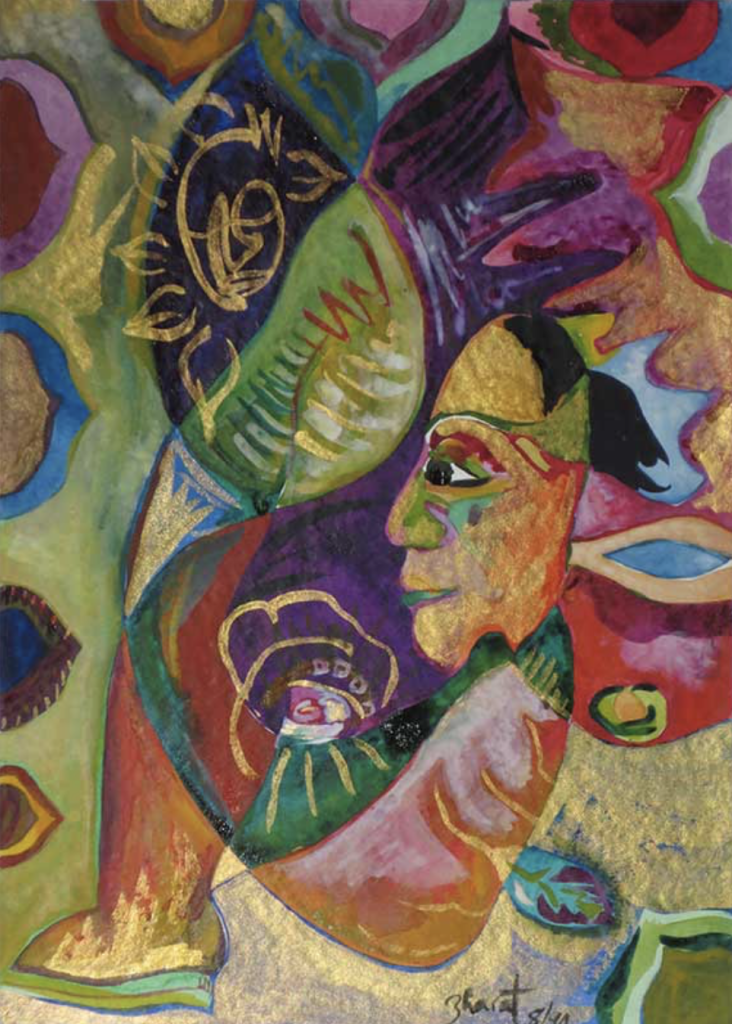
The three artworks presented here bring these ideas into intimate focus through faces, bodies, and surrounding patterns. In one composition, a profile emerges within a dense arrangement of leaflike shapes, curling contours, and smaller facial suggestions. Purple, green, red, and gold-colored passages move across the surface, creating a space that feels simultaneously bodily and botanical. The profile remains recognizable, yet its surroundings resist a clear boundary between person and environment. Read in relation to Harat’s broader practice, this interweaving suggests identity as something sustained through contact, memory, and the living world.
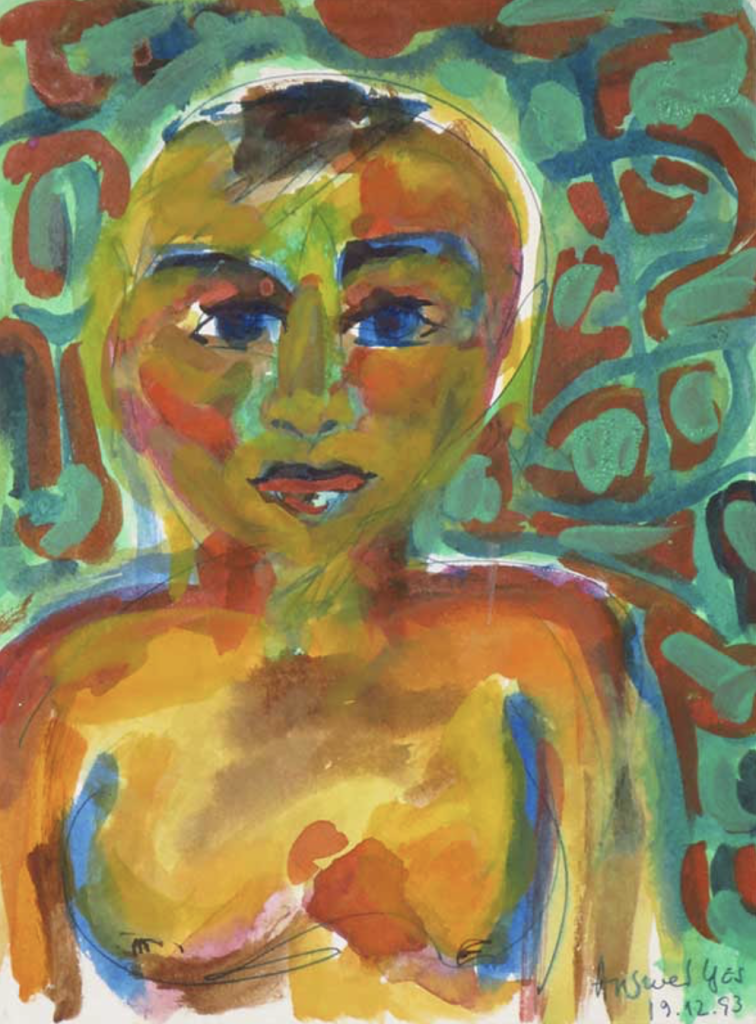
A second painting presents a frontal bust in yellow, orange, green, and blue. Broad, fluid passages describe the face and torso, while looping marks fill the surrounding turquoise field. The blue eyes establish an immediate point of contact. Elsewhere, overlapping washes loosen the body’s edges, allowing color to carry as much meaning as anatomy. Warmth and openness coexist with an expression that remains difficult to settle. The painting invites attention to that ambiguity, giving the subject room to appear self-possessed without becoming fully knowable.
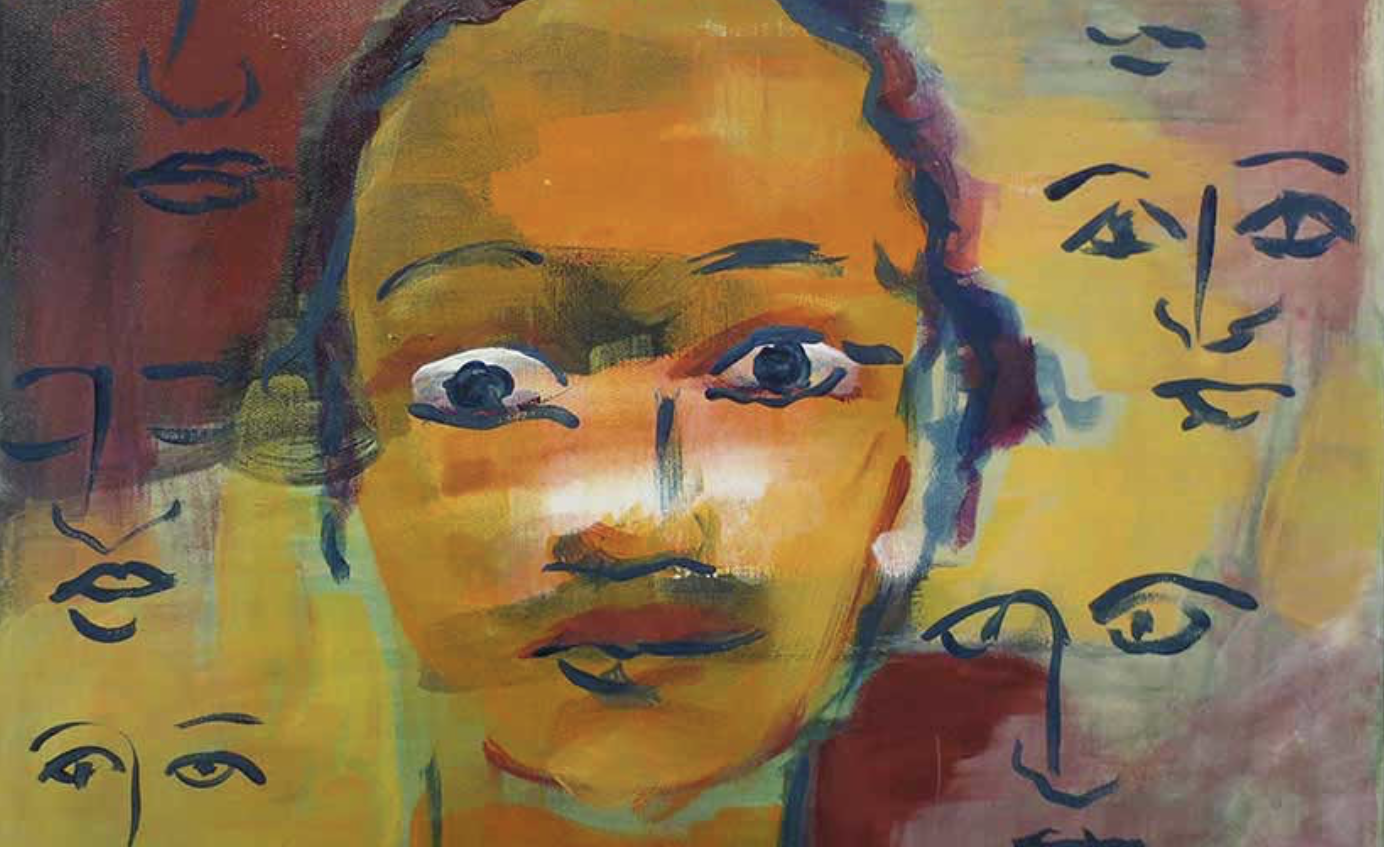
In the third work, a central face is surrounded by smaller faces outlined in dark blue. Some appear more complete than others, emerging from areas of pink, yellow, red, and pale green. Their repeated features create a visual rhythm, while differences in expression keep each presence distinct. The arrangement can suggest remembered encounters, an inward gathering of voices, or the experience of being seen from several directions.
Together, these paintings show how Harat uses portraiture without confining it to physical likeness. Faces become meeting points for emotion, perception, and relationship. Color links the individual to a wider field of experience, while recurring eyes return the viewer’s attention. Looking becomes reciprocal: we observe these painted presences, and their gazes ask us to consider our own position.
