

David Hathaway approaches painting as an encounter with uncertainty. Based in New York, the abstract artist works primarily with acrylic on panels, developing compositions through actions that both build and unsettle the surface. Paint is spread, scraped, dragged, and partially removed, leaving traces of earlier decisions within later passages. Tile trowels, rakes, combs, and scrapers extend his vocabulary beyond the brush, producing marks that resist complete control. His process moves quickly and intuitively, guided by subconscious responses and the possibilities opened by an accident. Forms emerge through repeated interruptions, while color establishes relationships that can shift with another gesture. Throughout this process, Hathaway looks for an emotional connection rather than a predetermined image. A finished painting holds the evidence of its construction: hesitation beside momentum, density beside openness, and arrangements that seem to have found their balance while remaining capable of change. Their uncertainty becomes part of their emotional presence.
Across the three paintings shown here, color and texture create spaces that feel continuously active. White drips, scratched lines, thick deposits, and broken patches overlap without settling into a single hierarchy. The eye moves between broad areas of color and smaller incidents embedded within them. Seen from a distance, each painting presents an overall rhythm. Closer inspection reveals competing directions and traces of activity that complicate that first impression.
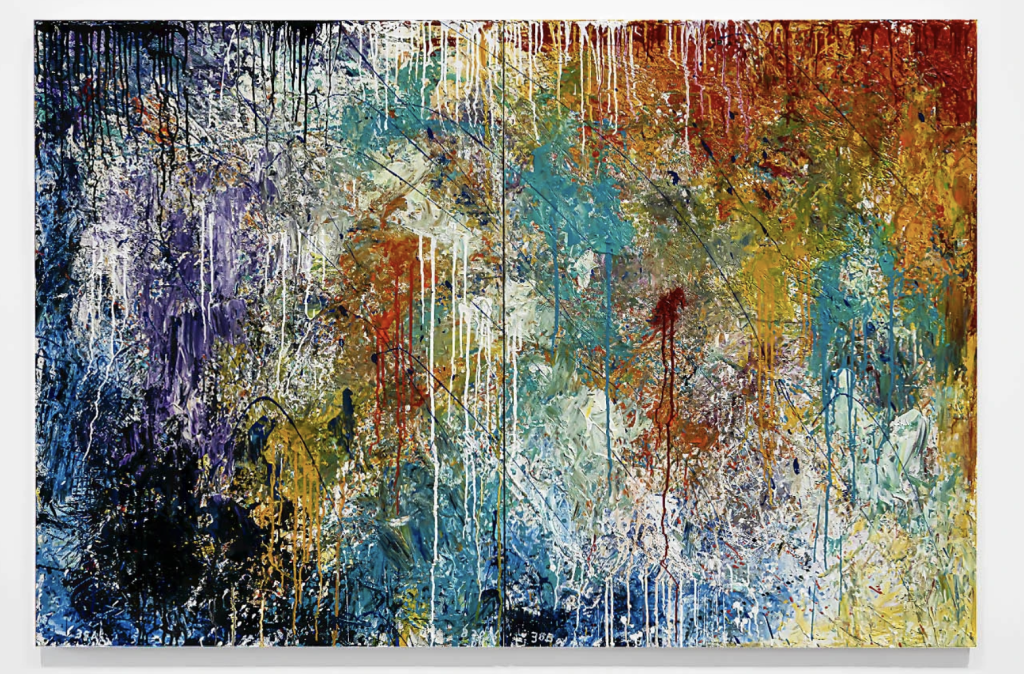
In the composition with deep blue and violet concentrated toward the left, the surface moves through turquoise and white into orange, yellow, and red toward the upper right. This transition gives the painting a changing temperature. Cooler passages suggest depth and shadow, while warmer areas appear to press forward. Neither remains isolated. Small interruptions carry colors across the composition, connecting regions that initially seem separate.
Long white drips provide a recurring vertical movement through this crowded field. Their downward paths contrast with thin diagonal lines and rough, irregular textures. Some drips remain distinct; others disappear into pale accumulations. This variation makes the surface difficult to read in a fixed sequence. A line might appear to sit above one passage before becoming absorbed elsewhere. The painting invites viewers to follow these crossings without promising a clear destination.
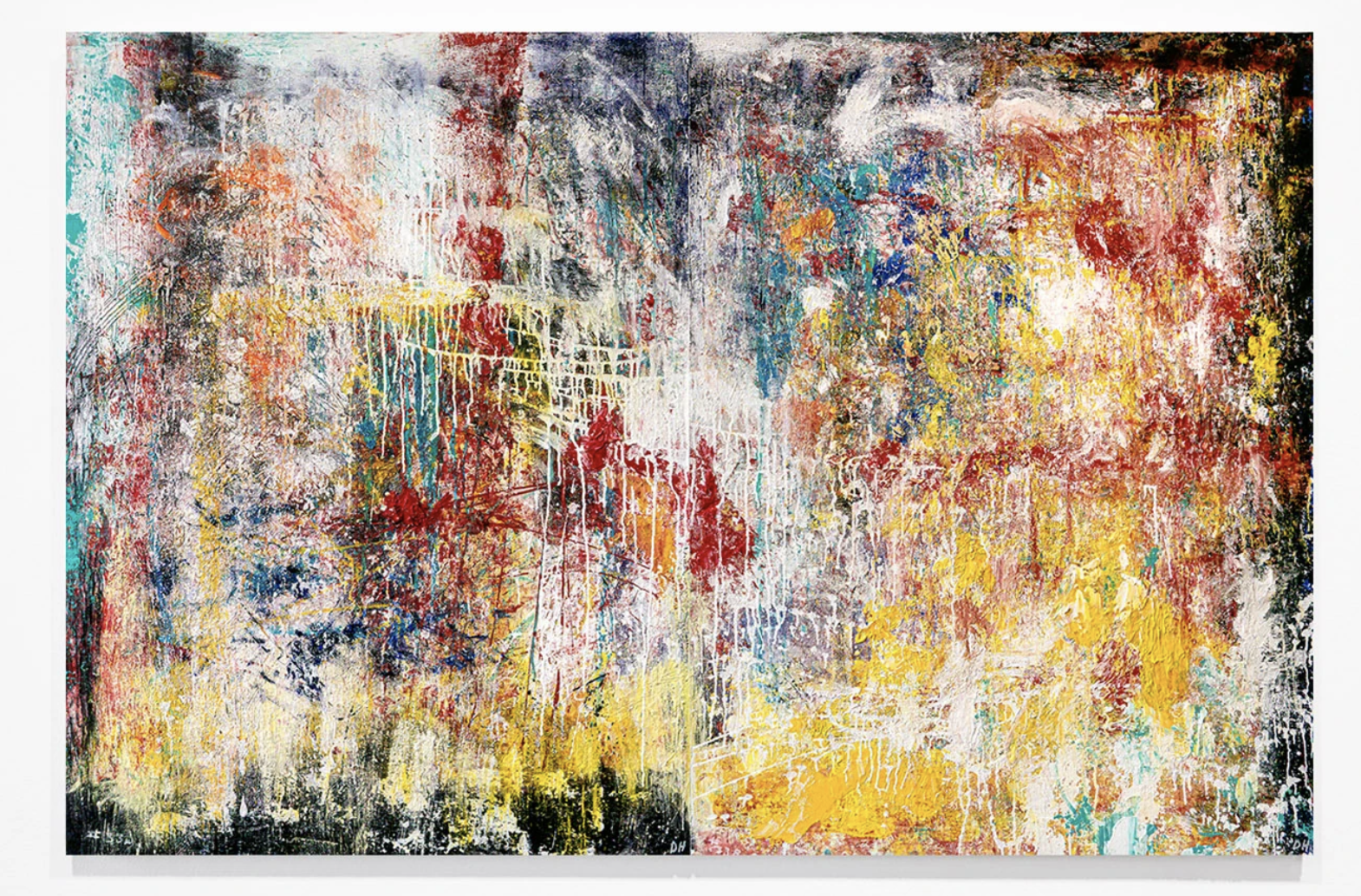
The work dominated by white, yellow, and scattered red introduces a different atmosphere. Pale layers veil portions of the underlying color, creating a sense of partial concealment. Turquoise, charcoal, and orange remain visible through the broken coverage. The result can suggest a wall repeatedly marked and repainted, although no literal setting is established. Its interest lies in how much survives beneath the apparent covering.
Within this painting, yellow gathers near the lower edge and spreads upward through the right side. Red marks interrupt the lighter areas, providing points of concentration within the diffuse surface. Dark passages along the bottom and upper edges give the composition weight. White lines and drips pass between these denser zones, creating connections that keep the painting moving even where the color appears obscured.
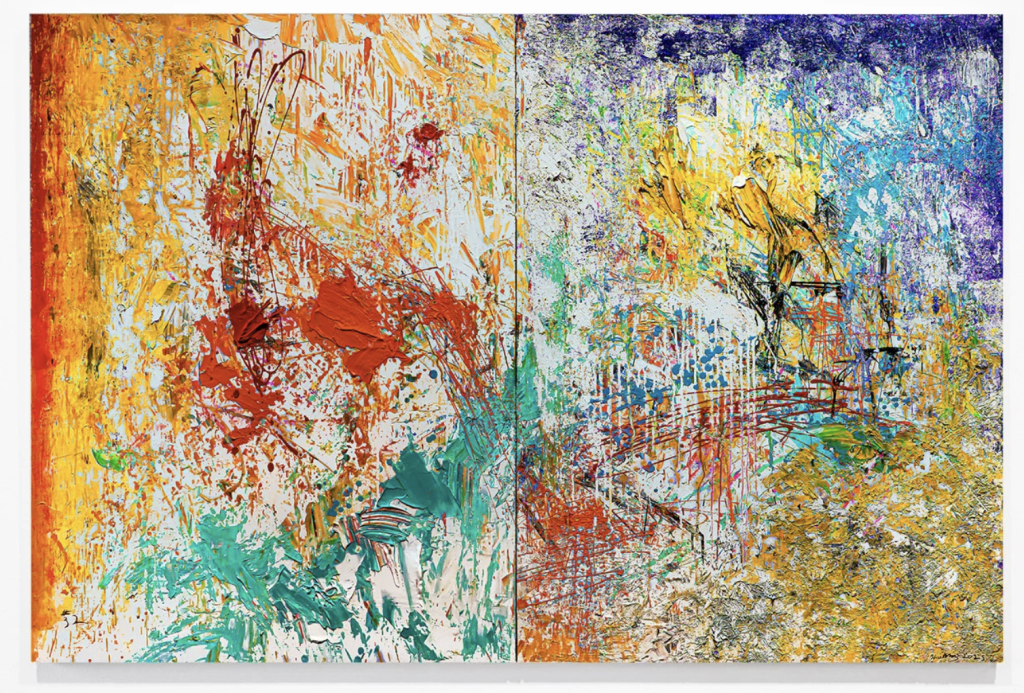
The third painting establishes a more pronounced exchange between warm and cool areas. Orange and yellow occupy much of the left section, while violet, blue, and turquoise gather across the right. Thick red gestures extend through the warmer field, countered by substantial turquoise marks below. These deposits give paint a physical presence. Their ridges and uneven edges suggest the resistance of material pushed across a surface.
Elsewhere, fine red lines sweep across the composition, crossing pale areas and joining otherwise distinct passages. Repeated grooves and small patterned impressions introduce another pace, asking the viewer to slow down. The contrast between broad gestures and closely worked textures creates several scales of activity within one painting. What first appears spontaneous gradually reveals a network of relationships among color, direction, pressure, and spacing.
All three works contain a visible central division, bringing the relationship between adjoining sections into focus. Marks and colors establish continuity across these seams, while differences in density preserve a degree of independence on either side. This creates another form of tension within Hathaway’s paintings: the surface can be read as a whole and as neighboring fields in conversation. Through these shifting relationships, his work makes room for recognition without fixing its subject. Viewers encounter energy, interruption, and persistence through the behavior of paint itself. Meaning develops through looking, as one detail changes the experience of the next.
