

Allan Wesaquate is a Canadian artist whose work transforms memories, dreams and personal experiences into expressive visual narratives. Through bold colour, simplified forms and textured surfaces, he creates paintings that invite viewers into psychological spaces where reality, imagination and symbolism freely intersect.
A Dream Reconstructed Through Paint
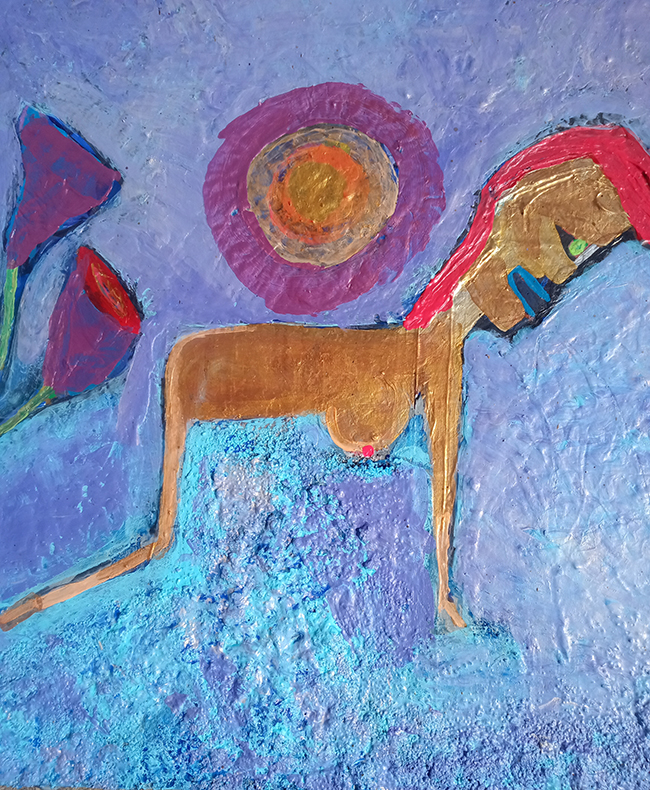
Created during the summer of 2026, Wesaquate’s Succubus originated in his memory of an erotic dream. Instead of attempting to reproduce the dream with realistic precision, he translates its atmosphere into an intensely tactile and highly personal image. The painting captures the fragmented quality of dreaming, where bodies, objects and emotions appear recognizable but do not necessarily follow the rules of waking life.
The central figure stretches across the composition in a sharply angular pose. Her body is rendered with elongated limbs and a geometric structure that gives her presence an almost emblematic quality. She appears suspended between movement and stillness, as though she has been caught in a single moment extracted from a longer dream. Her bent posture creates an immediate feeling of tension, while her simplified form prevents the scene from becoming an ordinary figurative representation.
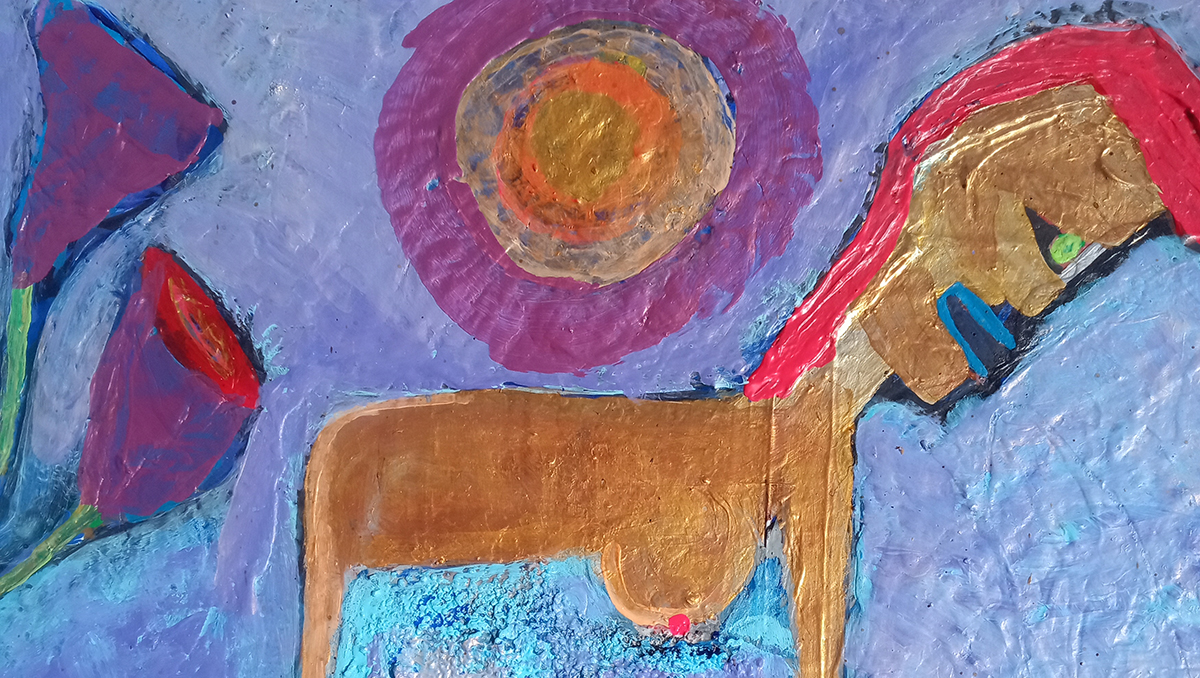
Wesaquate constructed the work using gesso, sand and acrylic paint on Masonite. These materials give the surface a physical intensity that is essential to the painting’s emotional effect. Sand mixed into the painted areas produces rough, irregular passages, especially throughout the blue lower section. This texture makes the dream feel materially present, as if an elusive memory has been given a surface that can almost be touched.
The contrast between the Masonite support and the uneven layers of gesso and sand also contributes to the work’s raw character. Rather than concealing evidence of its construction, the painting allows ridges, marks and changing densities to remain visible. These variations reflect the unstable way dreams are remembered. Some elements return clearly, while others dissolve, overlap or become altered by the act of recollection.
Colour, Symbolism and Psychological Space
Blue and violet dominate the surrounding environment, producing a cool, nocturnal atmosphere. Within this setting, the figure’s warm bronze and gold body becomes immediately prominent. Her vivid red hair forms an energetic accent, while areas of turquoise, green and dark blue animate the face. The unconventional colours move the figure away from ordinary human appearance and toward the realm of symbolism.
Behind her, a circular form composed of purple, orange and gold introduces another visual focal point. It might suggest a moon, sun, portal or concentrated field of energy, although the image does not require one fixed interpretation. Its placement above the figure gives it a watchful or magnetic presence. On the left, two purple and red plant-like shapes rise from green stems. They may resemble flowers, flames or organic forms emerging within the dream.
These surrounding elements do not establish a clearly identifiable location. Instead, they create a psychological landscape. The figure exists within an open field of colour in which scale and perspective remain fluid. This lack of conventional spatial structure is closely connected to Wesaquate’s understanding of dreams as experiences without dependable boundaries.
The title introduces the Western mythological figure of the succubus, traditionally imagined as a supernatural female presence associated with dreams and sexual encounters. Wesaquate observes that there is no directly equivalent character within his understanding of Indigenous culture. His painting therefore does not attempt to illustrate an Indigenous version of this mythology. It begins instead with an experience that crosses cultural classifications: the mysterious and sometimes erotic nature of dreaming.
This distinction gives the work an important conceptual tension. The title offers viewers a familiar mythological reference, but the image remains rooted in the artist’s individual memory rather than in a prescribed story. Wesaquate acknowledges that dreams may or may not have a foundation in reality. A psychologist might seek underlying causes or symbolic explanations, but the painting leaves those possibilities unresolved.
Between Memory and Imagination
One of the work’s most compelling qualities is its refusal to explain the dream completely. Its meaning remains open because the experience itself cannot be neatly reconstructed. The viewer is presented with a figure, an atmosphere and a collection of visual signs, yet no final narrative is imposed.
The erotic dimension is conveyed through pose, colour and psychological intensity rather than through detailed realism. The body is exposed but highly stylized, turning physical desire into something strange, distant and dreamlike. Its angularity contrasts with the circular shape above it and the organic forms nearby, establishing a dynamic relationship between the human body and its imagined surroundings.
In Succubus, Wesaquate transforms a private experience into a broader reflection on desire, memory and the unpredictable workings of the mind. The painting suggests that dreams do not need to obey cultural narratives, physical laws or rational explanations. Through its rough surface, vivid palette and distorted figure, it preserves the emotional force of a moment that exists somewhere between reality and imagination.
