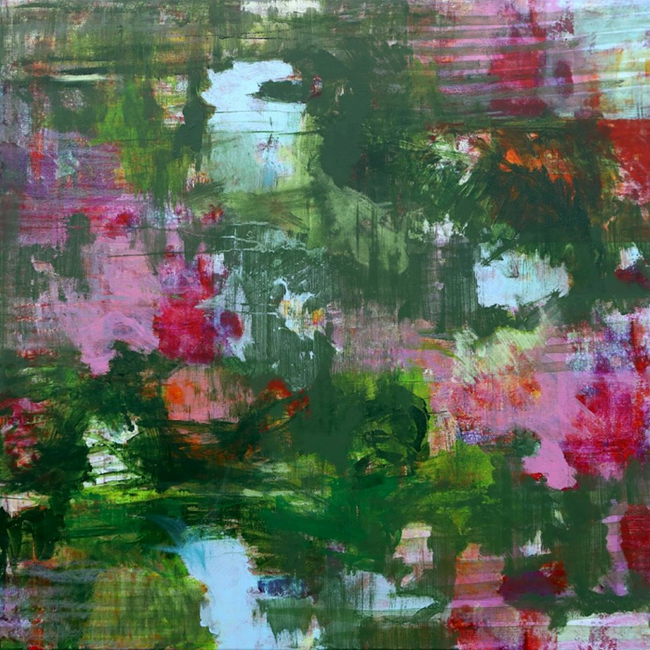

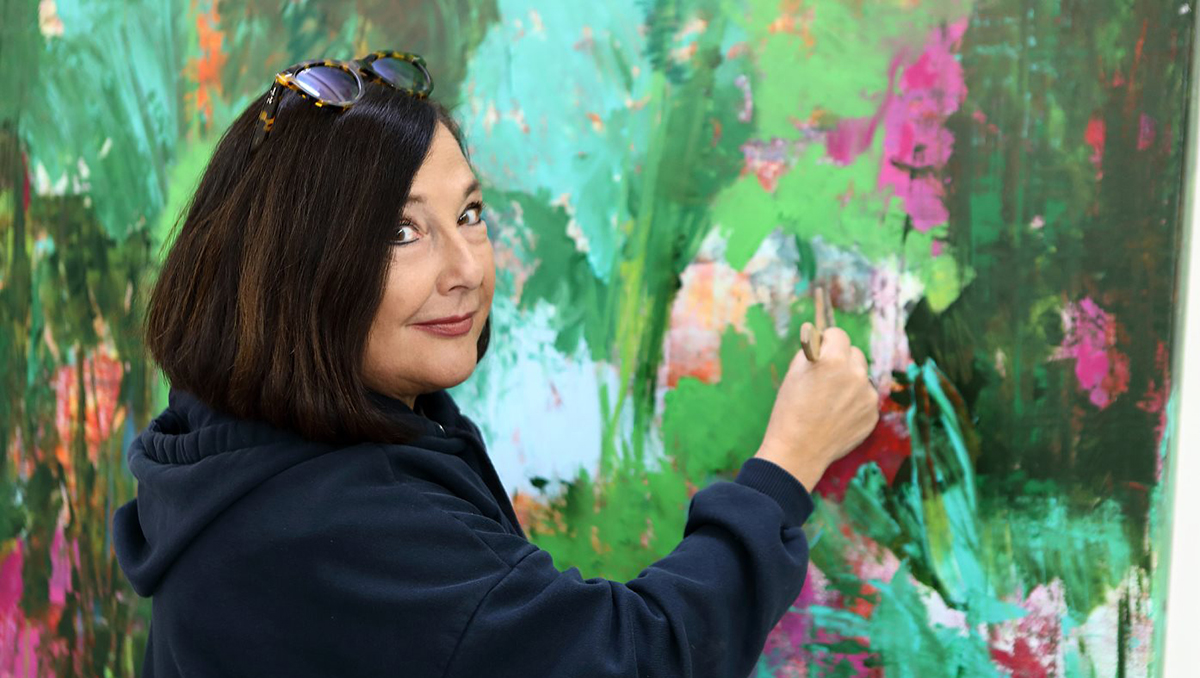
Sonja Kalb approaches abstraction as a living process in which colour, texture and gesture continually reshape one another. Born in Stuttgart and currently based in Düsseldorf, Germany, she holds a Dipl. Ing. degree in Textile and Applied Design. This training cultivated her sensitivity to material, pattern, surface and spatial organization, qualities that remain central to her paintings. Her artistic development moved through photography, studies of nature, portraiture and figurative work before arriving at collage and abstraction. By moving away from literal representation, Kalb discovered greater freedom to explore mood, movement and sensory experience. Her work has been exhibited internationally in museums, galleries, art associations and art fairs across Germany, Italy, France, the United Kingdom, the United States, Japan and South Korea. This September, her paintings will appear alongside sculptures by Kurt Grimm in MEET THE ARTISTS: Sonja Kalb & Kurt Grimm. The exhibition opens Friday, September 18, from 6 to 8 p.m.
The Living Pulse of the Natural World
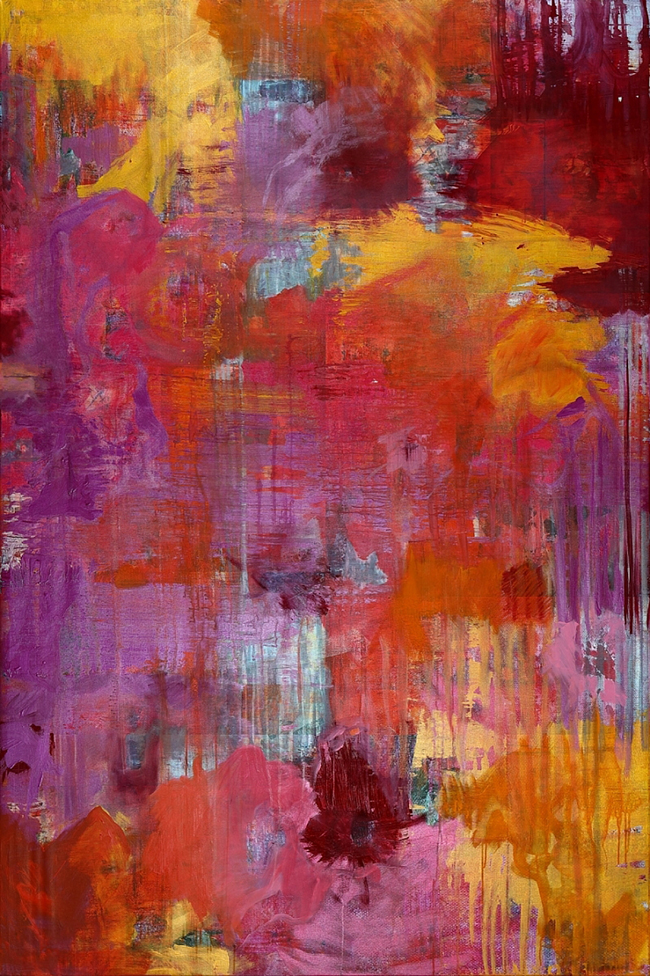
Nature enters Sonja Kalb’s paintings as an atmosphere rather than a clearly defined image. Her compositions do not attempt to recreate a particular landscape, flower or body of water. Instead, they capture the sensations associated with natural environments: growth, light, movement, change and the passing of time.
A curved gesture may suggest the movement of a branch in the wind. A luminous passage might recall sunlight passing through leaves, while a concentration of colour can evoke the richness of vegetation or the depth of an unfamiliar landscape. These impressions remain fluid and undefined, inviting viewers to form their own connections with what they see.
Kalb distills her observations into relationships between colour, shape and rhythm. By removing recognizable details, she creates paintings that feel connected to nature without being limited by a single subject. The natural world becomes a source of visual energy rather than something to be documented.
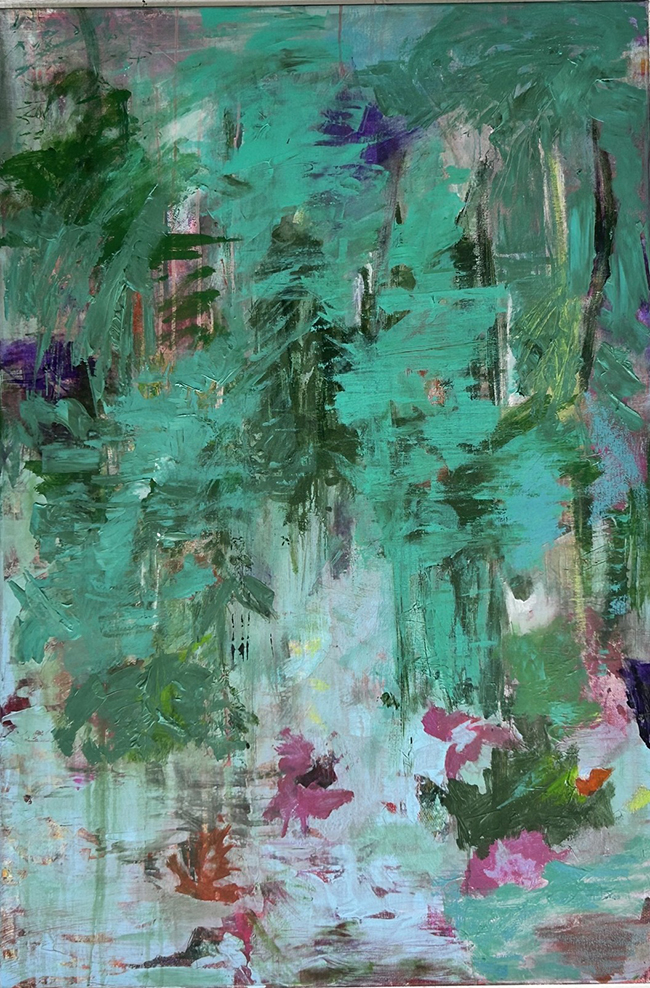
This openness gives the work a strong sense of possibility. Forms seem to hover between recognition and disappearance. They may feel familiar for a moment before dissolving back into abstraction. The viewer is encouraged to remain attentive, allowing personal memories and associations to develop gradually.
Movement is created through the interaction of contrasting passages. Some sections feel expansive and light, while others appear dense, concentrated or forceful. Broad gestures travel across quieter areas, producing shifts between activity and rest. These changes generate an internal rhythm that guides the eye through the composition.
The paintings rarely feel fixed or motionless. Instead, they suggest that something is unfolding across the surface. Colours overlap, shapes emerge from beneath other forms and transparent areas create the impression of space extending beyond the visible image. Each composition appears to contain several moments at once.
Kalb’s use of layers strengthens this sense of transformation. She constructs her paintings through a gradual process of addition, revision and removal. New areas of paint may conceal earlier decisions, while scraping or thinning the surface allows fragments of previous layers to reappear.
As a result, the paintings preserve evidence of their own development. A partially covered mark, a softened edge or a faint colour beneath the surface may reveal an earlier stage of the composition. These traces create visual depth while giving the work a history that remains present in its final form.
The process is responsive rather than entirely planned in advance. Kalb allows each decision to influence the next. A newly introduced colour may alter the balance of the entire painting, while an accidental mark can open an unexpected direction. She responds to these changes by adding, removing or reorganizing elements until the composition begins to establish its own logic.
Although spontaneity is essential to her practice, her paintings are carefully resolved. Kalb pays close attention to proportion, tension, rhythm and visual balance. Energetic gestures are offset by quieter passages, while complex areas are given room to breathe. The completed work results from an ongoing negotiation between intuition and deliberate judgment.
Her background in Textile and Applied Design can be recognized in this careful attention to organization. Textile design depends upon an understanding of how repeated forms, colours and textures interact across a surface. Kalb carries this awareness into her paintings, where rhythm and variation provide an underlying structure.
Yet structure never dominates the work. Repeated elements are disrupted, patterns shift and ordered arrangements are interrupted by expressive marks. A sudden change in direction or scale may challenge the stability of the composition. This tension between organization and unpredictability prevents the paintings from becoming static.
Colour plays a particularly powerful role. In Kalb’s work, it is not applied simply to describe an object or beautify a surface. It operates as an independent presence capable of establishing mood, distance and movement. Intense colours may appear to advance toward the viewer, while translucent or darker tones create a feeling of recession.
The relationships between colours also shape the emotional character of each painting. Closely related tones can produce calm, gradual transitions, while contrasting hues introduce energy and visual friction. At times, colour feels expansive and uplifting; elsewhere, it becomes quieter, more mysterious or contemplative.
Kalb does not prescribe how these combinations should be understood. Emotional responses remain personal and may differ from one viewer to another. A composition that appears peaceful to one person might feel uncertain or restless to someone else. This ambiguity is part of the work’s strength.
Her paintings also reward sustained viewing. The first impression may be dominated by large gestures, bold contrasts or areas of saturated colour. As the eye adjusts, less immediate details begin to appear. Fine textures, delicate transitions and concealed forms reveal themselves slowly, adding new dimensions to the experience.
Working in series allows Kalb to extend this exploration across multiple paintings. Rather than attempting to resolve an idea within a single work, she studies it through different palettes, formats, gestures and surface treatments. Each painting becomes an individual variation within a larger creative investigation.
Certain themes may disappear from her practice and return years later. When Kalb revisits an earlier subject, she approaches it with new experiences and an altered perspective. The result is not a repetition of what came before but a continuation that reveals how both the artist and the idea have evolved.
This cyclical method parallels the processes found in nature itself. Seasons return but never appear exactly the same. Organic structures grow, fade and reemerge in altered forms. Similarly, Kalb’s recurring themes remain open to renewal, allowing past explorations to generate new visual possibilities.
The physical character of paint is equally important. Brushwork, scraped sections, layered pigments and textured surfaces make the actions of the artist visible. The paintings retain the force, direction and pressure of the gestures that created them. Their material presence cannot be separated from their meaning.
This quality becomes especially powerful when the work is viewed in person. From a distance, the overall arrangement of colour and movement may command attention. At close range, subtle irregularities, overlapping edges and underlying layers become more apparent. The experience changes as the viewer moves around the work.
Kalb’s paintings ultimately offer spaces for reflection rather than fixed explanations. They hold opposing qualities in balance: control and spontaneity, density and openness, tranquillity and energy. Through these contrasts, the familiar rhythms of nature are transformed into an abstract visual language.
Her work does not reproduce the natural world as it appears. Instead, it conveys nature as an active and continually changing force. Colour, gesture and material combine to express moments of emergence, transition and disappearance, reminding viewers that neither nature nor perception ever remains completely still.
Sonja Kalb’s Upcoming September Exhibition
MEET THE ARTISTS: Sonja Kalb & Kurt Grimm
Opening: Friday, September 18, from 6 to 8 p.m.
Meet the Artists: Both artists will be present for an engaging evening of conversation.