

Bart Levy approaches painting as a way of holding onto the sensations that remain after looking at nature. Working with oil and cold wax, Levy builds landscapes and floral compositions in which texture carries as much meaning as the subjects themselves. Flowers, fields, and skies remain recognizable, yet their edges often dissolve into passages of color and gesture. This movement between description and abstraction gives the paintings an openness, allowing observation to mingle with memory.
Through repeated applications and scraping, Levy preserves traces of earlier stages within each surface. These accumulated marks suggest time passing, with each adjustment contributing to the painting’s character. Rather than recording a particular location with precision, the work explores how a place or encounter feels. Across these paintings, nature becomes a starting point for reflection, inviting viewers to slow down, follow the movement of paint, and discover their own associations within its layered spaces.
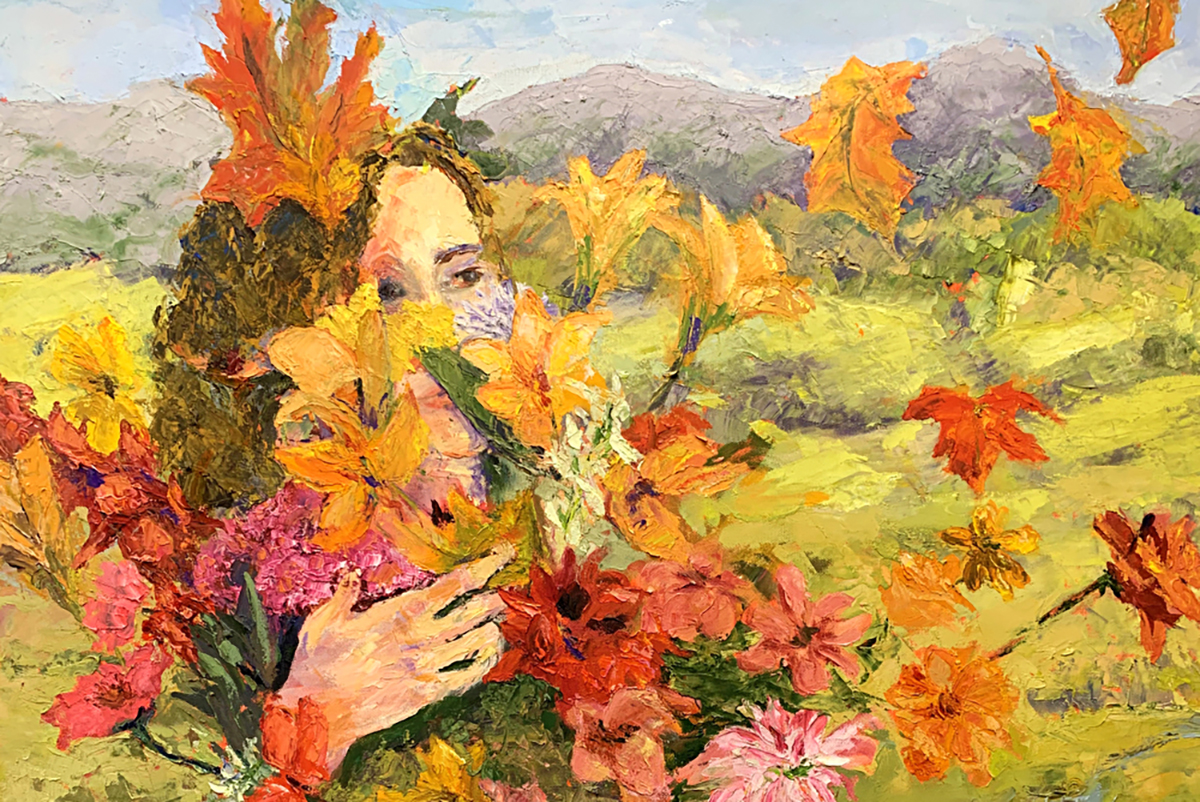
In Autumn’s Embrace, the relationship between human presence and the natural world becomes almost inseparable. A person’s face emerges behind a gathering of flowers and leaves, while a hand rests across the arrangement. The surrounding landscape extends into distant hills beneath a pale sky. Yet the painting’s emotional center lies in the close contact between body and blossoms. The flowers appear to surround, shelter, and partly conceal the person, creating an image that can suggest affection, remembrance, or immersion in the season.
Orange leaves move across the composition, carrying the eye upward and outward. Their pointed shapes contrast with the rounded flower heads and the softer contours of the face. Reds, yellows, and pinks gather densely around the torso, while olive and yellow greens connect this central grouping to the ground. The textured handling prevents these elements from becoming separate illustrations. Instead, skin, petals, foliage, and terrain share a common material language, bringing the entire scene into a continuous, shifting field of paint.
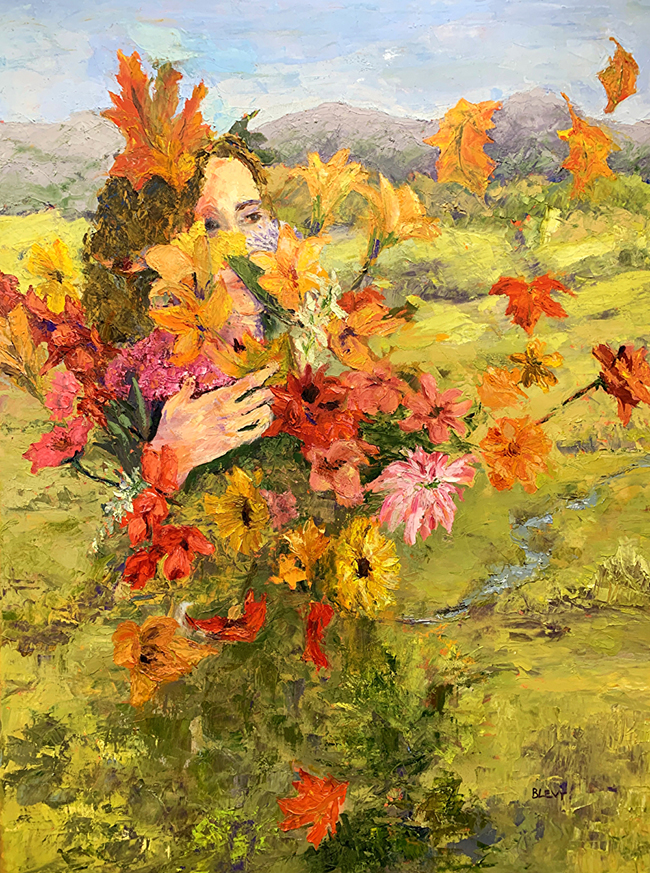
This continuity gives Autumn’s Embrace an ambiguity. The viewer can read it as a person holding flowers, but the abundance also makes it feel as though the landscape itself has taken human form. Levy leaves that relationship unresolved. The painting’s tactile surface encourages attention to individual marks, even as the arrangement remains readable from a distance. Its seasonal imagery carries warmth alongside an awareness of change, with suspended leaves suggesting a moment that cannot remain still.
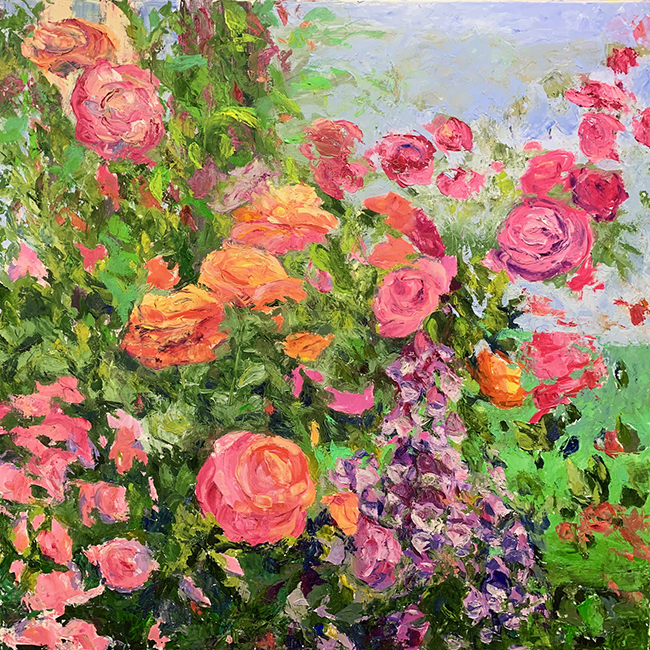
Everything’s Coming Up Roses brings the viewer much closer to floral growth. Here, blossoms fill the square composition, leaving little room for a distant viewpoint. Pink and coral roses unfold among orange flowers, deep green foliage, and a descending cluster of purple blooms. A pale blue opening near the upper right offers a brief visual release from the surrounding density. This glimpse of space helps the flowers feel expansive, as though the garden continues beyond the canvas.
The roses are described through curling strokes and layered patches rather than precise outlines. Some blooms appear fully formed; others emerge through a few suggestive movements of color. Darker greens create pockets of depth, while lighter marks bring leaves and petals forward. This uneven degree of definition gives the painting its rhythm. Looking becomes an active process of finding shapes, losing them in the surface, and discovering them again. The garden feels alive through these changing relationships between clarity and suggestion.
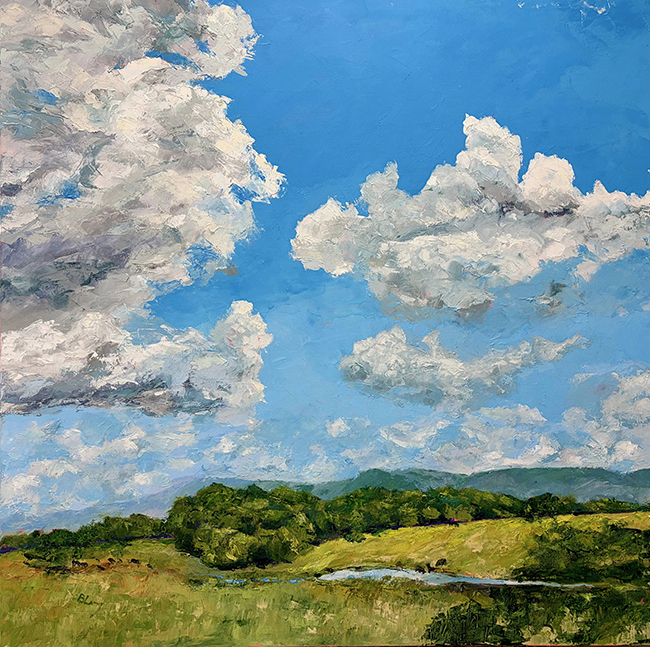
In High Summer, Levy opens the composition to a broad sky. Large white and gray clouds occupy most of the canvas, rising above a low band of trees, fields, and distant hills. A narrow stretch of water catches light near the foreground. The scale of the sky changes the viewer’s experience: the close abundance of the floral painting gives way to distance, air, and a sense of breathing room.
Clouds remain substantial through their textured construction, with gray passages lending weight beneath brighter edges. Below, varied greens and warm earth tones keep the land active without competing with the sky. Across these three works, Levy adjusts space and density while maintaining an interest in paint as a record of attention. Whether looking into a garden, across a field, or toward a face surrounded by flowers, the viewer encounters nature through surfaces that retain the movement of their making. These paintings reward sustained looking because their subjects and materials continually inform one another, allowing familiar scenes to become personal experiences of color, texture, and time.
