
Vandorn Hinnant is a multidisciplinary artist whose work investigates consciousness, ancestral wisdom, intuition, and the invisible forces that may exist beyond ordinary perception. For nearly five decades, his visual practice and writing have evolved in connection with personal experiences he associates with the spiritual realm. Rather than treating accounts of shamans, ancestors, and non-physical beings purely as mythology, Hinnant views them as part of humanity’s continuing search for realities that extend beyond the five senses.
Hinnant sometimes describes his images as “soul sketches” or “spirit whisperings.” These expressions reflect his desire to translate intangible energies and inner perceptions into visible form. Within his practice, art is not simply decorative. It can serve as a psychological and spiritual instrument through which unseen experiences are recorded and communicated.
This idea unites his organic and geometric abstractions. Lines, shapes, colors, and symbols become a visual vocabulary for documenting intuition, visionary impressions, and encounters that cannot be represented through direct observation.
The Artist as a Spiritual Intermediary
The figure of the shaman holds an important place within Hinnant’s artistic philosophy. Across many ancient cultures, shamans were understood as intermediaries capable of moving between physical reality and the spiritual world. Hinnant draws upon this archetype to consider whether the artist may perform a comparable role by receiving intangible impressions and giving them material presence.
His paintings do not claim to provide scientific proof of spiritual phenomena, nor do they attempt to define such experiences through established religious teachings. Instead, they create spaces for reflection. Viewers are invited to consider forms of knowledge that may exist beyond conventional explanation.
Recurring elements such as stars, spheres, vessels, dwellings, connecting lines, and open landscapes form part of Hinnant’s distinctive symbolic language. Within these imagined environments, consciousness is presented as active and capable of movement. The soul is not confined to the physical body but may travel through unfamiliar dimensions while maintaining a connection to its earthly form.
Hinnant found meaningful confirmation of these ideas when he encountered the life and work of Hilma af Klint through the Guggenheim Museum’s 2018–2019 exhibition, Hilma af Klint: Paintings for the Future. Af Klint’s use of abstraction to express spiritual experiences offered him a broader historical context for examining his own creative development.
For Hinnant, learning about her work felt like a homecoming. It reinforced his understanding that an artist may create images long before the surrounding culture has developed the language or perspective necessary to interpret them.
Shaman’s Dream: Consciousness Beyond the Body
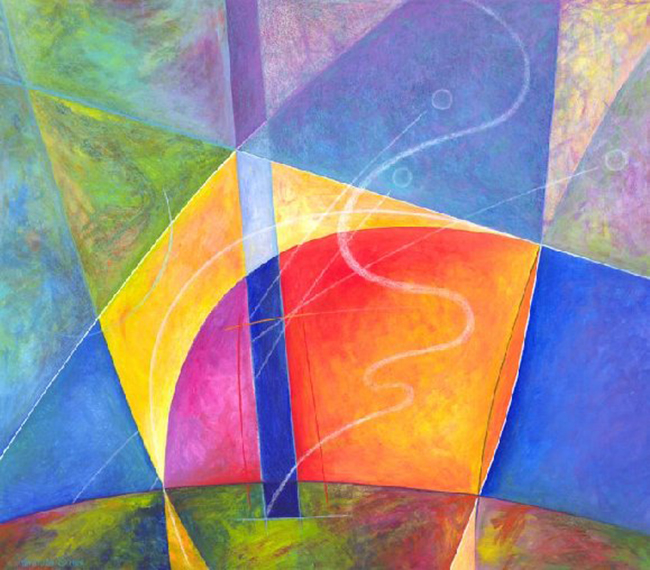
Completed in 1989, Shaman’s Dream was created with acrylic paint and Prismacolor pencils on a gessoed substrate. Measuring 21 by 24 inches, the composition combines an isolated dwelling, a curved horizon, three translucent spheres, and a network of fine connecting lines. Although the imagery appears abstract at first, every component contributes to the spiritual meaning of the work.
The dwelling stands within the landscape as both a physical shelter and a place of ceremony. A faint trail of smoke emerges from a form resembling an entrance, suggesting that an unseen ritual or transformation may be occurring inside. Below it, a gently curving line defines the surface of the earth and separates the grounded environment from the expansive space above.
Three transparent orbs float within the sky. Hinnant identifies these luminous forms as the souls of three shamans whose physical bodies remain inside the structure. Their consciousness has traveled into a higher dimension, but it has not become entirely separated from the body.
Thin lines connect the spheres to their physical vessels, functioning as energetic tethers. These delicate links allow the traveling souls to explore beyond the material world while preserving a pathway back to embodied existence.
Through this symbolic arrangement, Hinnant gives form to accounts of spiritual travel found within numerous mystical and cultural traditions. Rather than representing the shamans through recognizable human figures, he portrays their consciousness through light, transparency, and movement across space. Their identities are no longer defined by physical appearance. They become radiant presences traveling through an unseen realm.
Shaman’s Dream is also connected to Hinnant’s wider exploration of what he calls the “eye of the soul.” Since his earliest intentional experiments with mark-making, he has attempted to record images perceived internally rather than observed through physical vision. Throughout his organic and geometric compositions, the artwork becomes a trace of an inward experience and a record of something sensed but normally invisible.
Mother Ship: A Vision Completed Decades Later
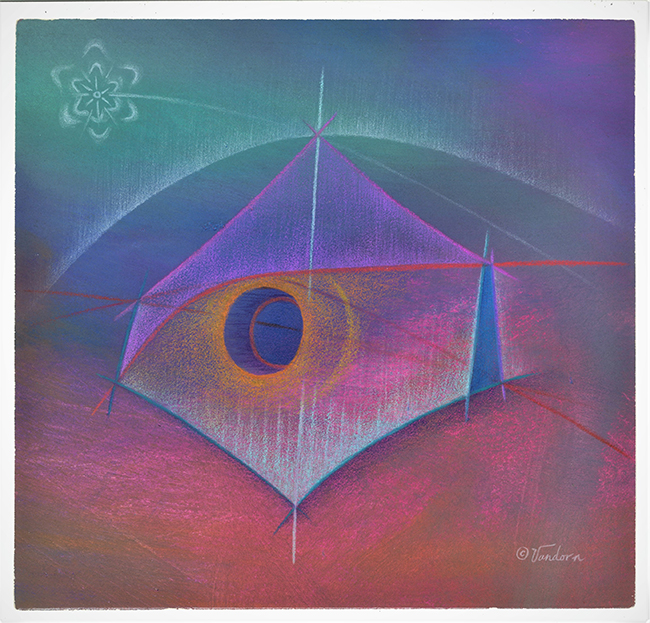
Dated 1991/2023, Mother Ship was created with acrylic paint and Prismacolor pencils on cotton rag paper. The 9.6-by-10.125-inch composition depicts a vessel guided by a sentient navigator as it travels across an enigmatic landscape.
A six-pointed star appears overhead, connected to the vessel by a narrow trail of light. Hinnant suggests that this star may symbolize the navigator’s soul existing temporarily beyond the body. Similar to the connecting lines in Shaman’s Dream, the illuminated path acts as a tether between consciousness and physical form.
Although the soul has ventured outward, it continues to guide the vessel through unfamiliar surroundings. The body and spirit remain separate yet interconnected, participating together in the journey.
Circular openings contribute to the appearance of a constructed vehicle, while the surrounding terrain avoids belonging to any recognizable historical period or geographical location. The scene could represent a forgotten past, an undiscovered future, or a dimension that exists outside conventional time.
This ambiguity is central to Hinnant’s work. His compositions rarely follow a fixed chronology. Instead, they explore qualities of consciousness that he regards as timeless, allowing ancient memory, futuristic possibility, and spiritual experience to occupy the same visual space.
The history of Mother Ship also reveals the extended process through which some of Hinnant’s ideas reach completion. He produced the original black-and-white study in 1991 and carried it with him for more than thirty years before developing the image in color in 2023. Many additional drawings and sculptural paper studies remain within his archive, awaiting the moment when they may be transformed into more permanent works.
Together, Shaman’s Dream and Mother Ship demonstrate Hinnant’s sustained commitment to translating intuitive experience into visual language. In both compositions, art becomes a vessel capable of crossing boundaries between body and soul, ancient knowledge and future possibility, and the visible world and the mysteries that may exist beyond it.
