

Doug Caplan, born in 1965 in Montreal, Quebec, Canada, has lived with photography as both a companion and a challenge for most of his life. His first camera was a black-and-white Polaroid, a gift from his parents when he was a teenager. The camera was simple, even clunky, but its instant magic stuck with him. He remembers the disposable flash, the mechanical click, and especially the sharp smell of the chemicals as the image formed. For years, that memory lingered without pulling him fully into the art. Only after his marriage in the early 1990s did he return to photography with a sense of direction. What had once been a pastime grew into a discipline. Working across both analog and digital forms, Caplan traces moments of light, motion, and stillness. His pictures speak to the rhythm of everyday life, always hinting at something just beyond the surface.
Luminara: A Window Into Motion
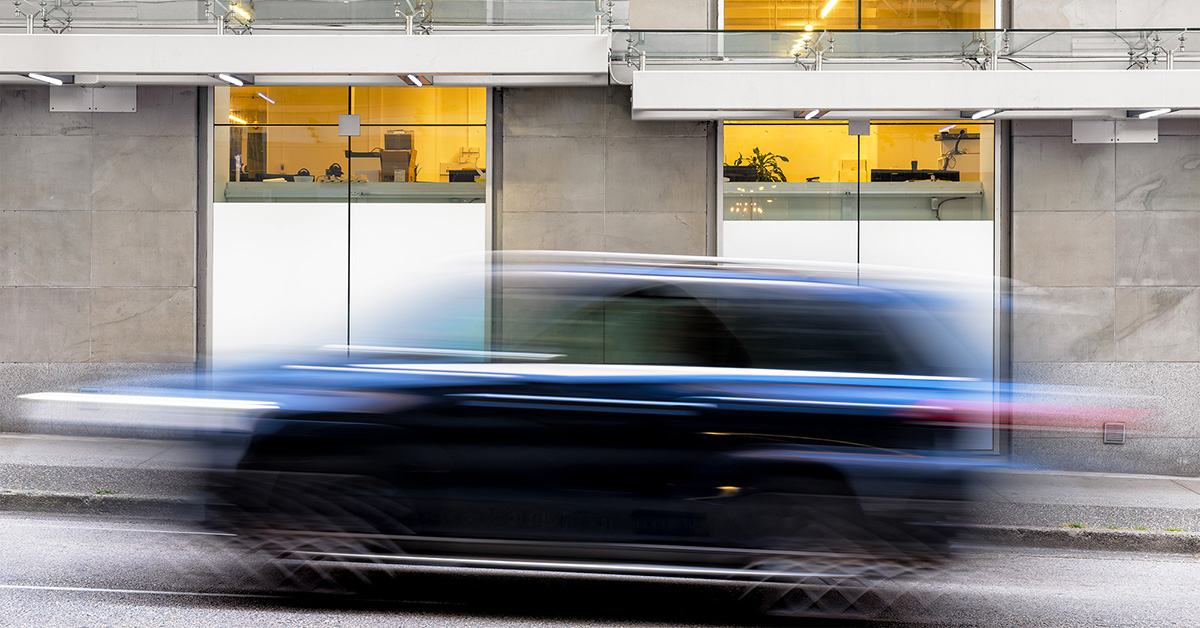
Luminara is not just a photograph. It’s a slice of the city at night, caught between breath and blur. A car rushes by, leaving only a dark smear across the frame. Behind it, windows glow, steady and calm. One part of the picture races forward, the other holds its ground. That tension—between speed and stillness—is the core of the work.
Caplan has always been drawn to light, and here it becomes the anchor. The glow of the windows isn’t just warm; it feels inhabited, alive. You don’t see the people inside, but you know they are there. The car, on the other hand, is faceless and fleeting, gone before you can name it. Together, they stage a kind of play: motion against rest, absence against presence. The effect is cinematic, like a single frame stolen from a longer story.
The photograph also holds a paradox. It freezes time while showing movement. The blurred car is a reminder that even in stillness, things are moving too fast for us to hold on. Caplan’s camera doesn’t just capture—it interprets. By slowing down the rush of the city into a single frozen streak, he invites us to notice what usually slips past.
There’s an intimacy in Luminara. Street photography often deals in spectacle, catching dramatic gestures or unusual encounters. Caplan resists that. His subject here is an ordinary street. There is no landmark, no grand architecture. The magic comes from seeing the familiar in a new register. A simple car, an anonymous building, light in the windows—these are things we overlook every day. Yet in his lens, they become theater.
Light carries symbolic weight as well. In Luminara, it acts as both shield and reveal. The windows shine but don’t disclose. You can’t peer inside; you can only sense what might be happening behind the glass. The car’s blur is a shadow, a kind of erasure. It blocks the view yet signals presence. What remains visible is only part of the whole. Caplan suggests that city life is always layered—seen and unseen, moving and fixed, present and absent.
The photograph also asks us to pause. Cities are built on motion. People hurry from place to place, cars weave through traffic, lights change with mechanical rhythm. Rarely do we stop to notice how light shapes the streets. Caplan’s work interrupts that rush. By isolating a brief instant, he gives weight to something we might otherwise miss. The act of viewing becomes an act of slowing down, even resisting the city’s relentless pace.
Composition matters here too. The blur of the car cuts across the lower frame like a dark river, while the building behind forms a calm grid of windows. The balance is deliberate. Without the car, the picture would be static. Without the windows, it would collapse into pure abstraction. Together, they sustain the tension that makes the image resonate.
On a larger scale, Luminara fits into Caplan’s ongoing interest in the dialogue between analog and digital photography. The picture feels immediate, rooted in the tactile sense of film, but it also carries the sharpness and precision that digital tools allow. That duality mirrors the subject itself—past and present, fast and slow, fleeting and enduring.
In the end, Luminara isn’t about the car or the building. It’s about the space between them, the way light and motion carve meaning out of an ordinary night. Caplan takes what might have been overlooked and turns it into a quiet meditation. The city shifts quickly, but for a moment, we are asked to look closer. And in that pause, the everyday becomes extraordinary.
