

Another submission has arrived through Peter Parker. Whether this is his real name or a playful reference to comic book history remains an entertaining mystery. The coincidence feels especially appropriate because the paintings he supports appear to have emerged directly from the dramatic world of illustrated heroes and villains. Parker is not the artist responsible for these works. Instead, he serves as an advocate and sponsor for their creator, helping bring greater attention to a distinctive practice. His role may remain behind the scenes, but this kind of encouragement can be essential to an artist’s development and visibility.
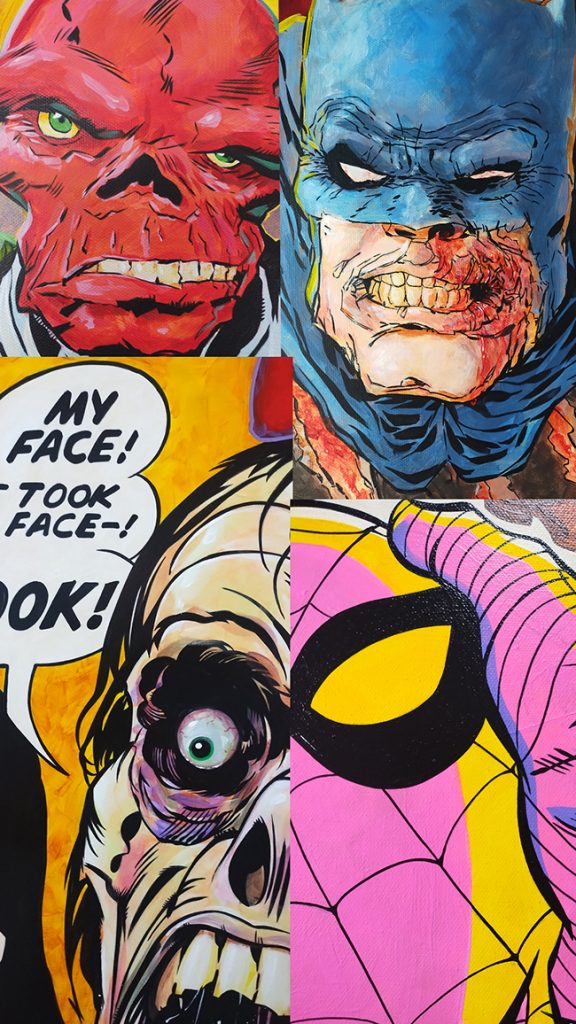
This beautiful paintings are created by Pete “PG” Garcia, an artist specializing in large-scale recreations of comic book covers and interior pages. The submitted collection highlights reinterpretations of original works by Jack Kirby, Frank Miller, and John Romita. Through paint, scale, and carefully controlled color, Garcia transforms familiar printed imagery into bold physical artworks while preserving the nostalgia that made the original illustrations memorable.
From Printed Page to Painted Canvas
Comic books are designed to be held in the hands and read through a sequence of relatively small panels. Garcia changes this familiar relationship by transferring selected images onto large canvases. Once enlarged, details that might pass quickly during reading become impossible to overlook. Facial expressions, ink lines, color blocks, and dramatic gestures acquire a commanding presence.
This shift in format does more than reproduce the original image. It changes how viewers encounter it. A printed comic panel is part of a continuing narrative, while a painted recreation can stand independently as an object of contemplation. The action appears momentarily suspended, allowing the viewer to examine the visual construction of a scene instead of immediately moving to the next panel.
Garcia explains that his goal is to give both vintage and contemporary comics new life through color while maintaining their iconic qualities and the nostalgia they hold for collectors. That balance is central to his work. The paintings must remain recognizable enough to awaken memories, yet they must also carry the unmistakable presence of paint and the artist’s hand.
Faces Filled With Conflict
The submitted collection concentrates heavily on the face. Among the images are tightly cropped portraits of comic-book figures shown through expressions of menace, pain, shock, and determination. Rather than presenting heroes and villains in full-body action poses, Garcia moves viewers uncomfortably close to them.
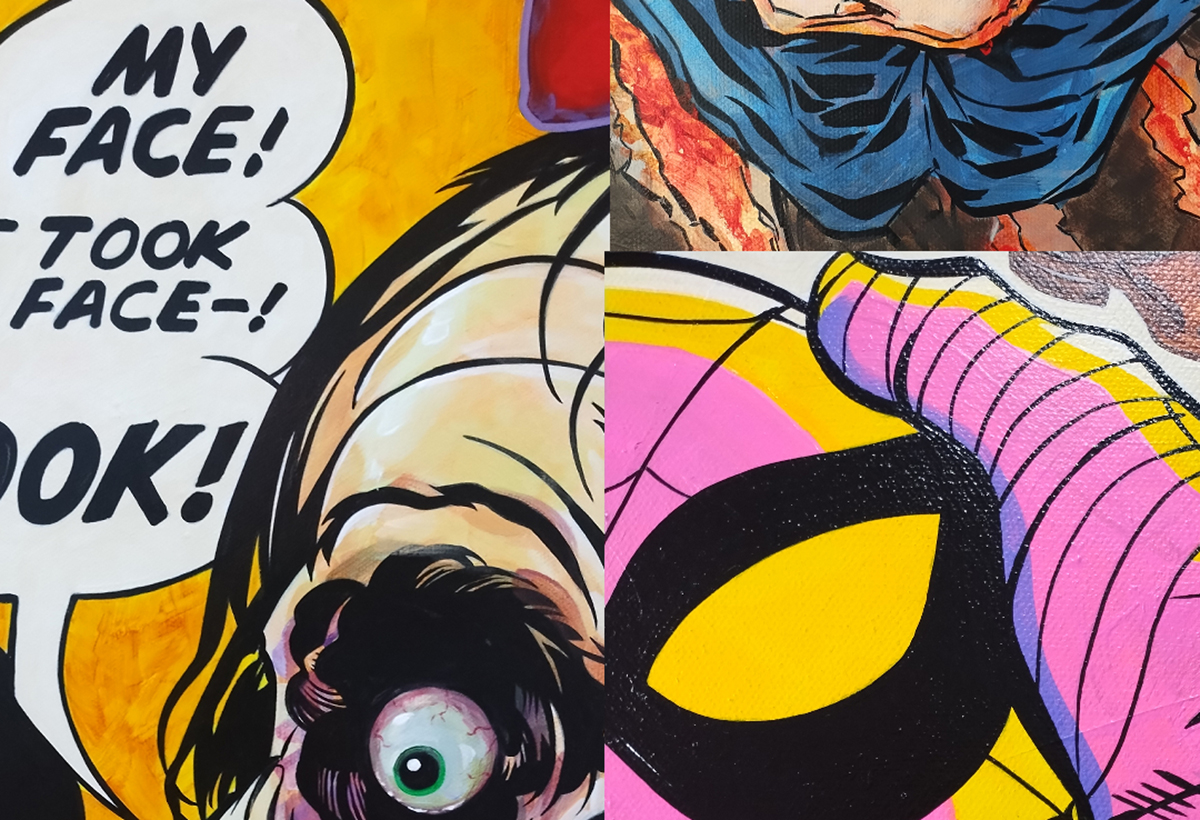
In one section, a vivid red face fills nearly the entire canvas. Acidic green eyes stare outward beneath a sharply furrowed brow, while exposed teeth intensify the expression of contained aggression. Black contour lines cut across the red, pink, and orange surface, preserving the forceful graphic character of comic illustration. At this enlarged scale, the face becomes less like a single character portrait and more like a study of rage.
Another painting depicts Batman with visible injuries across his face. His blue cowl frames clenched teeth, bruised skin, and streaks of blood. The image avoids presenting the hero as invulnerable. Instead, Garcia emphasizes exhaustion, physical damage, and persistence. Batman remains recognizable, but the focus falls upon the cost of conflict. The visible brushwork gives the injuries a rawness that differs from the smooth mechanical finish of commercial printing.
Drama Through Cropping and Color
Garcia’s use of cropping strengthens the psychological intensity of the work. A partial face, an isolated eye, or the recognizable pattern of a costume provides enough information for viewers familiar with comic imagery to complete the character mentally. This reflects the economy of comic-book storytelling, in which a carefully selected fragment can communicate an entire moment.
One composition is dominated by a bulging green eye surrounded by distorted facial features and an urgent speech balloon. The words are partially cut off, creating a sense that the viewer has entered the scene in the middle of a crisis. Language becomes a visual form as much as a narrative device. Thick black lettering, a white balloon, and an intense yellow background combine to reproduce the urgency of a shouted line.
Elsewhere, a tightly framed Spider-Man mask is transformed through unexpected pink, yellow, purple, white, and black. The familiar web pattern holds the composition together, while the bright palette pushes it toward Pop Art. The result feels simultaneously nostalgic and contemporary. Viewers recognize the cultural symbol immediately, but the heightened color allows them to experience it anew.
Preserving Nostalgia Through Paint
Nostalgia is not simply a longing for the past in Garcia’s work. It becomes an active relationship between personal memory and material transformation. Comic covers and panels may remind collectors of childhood reading, favorite characters, or meaningful moments of discovery. By recreating those images as substantial paintings, Garcia gives these memories a physical scale suited to their emotional importance.
His canvases also celebrate the visual intelligence of comic-book art: its dramatic framing, expressive linework, compressed storytelling, and fearless use of color. Through enlargement and hand-painted interpretation, elements once created for inexpensive printed pages take on the presence of gallery-scale images.
Pete “PG” Garcia’s work occupies a compelling space between tribute, transformation, and personal memory. He does not attempt to separate comic imagery from its popular origins. Instead, he embraces its familiarity and demonstrates why these pictures remain powerful. His paintings allow iconic characters to leave the page, claim new space, and confront the viewer face-to-face.
