

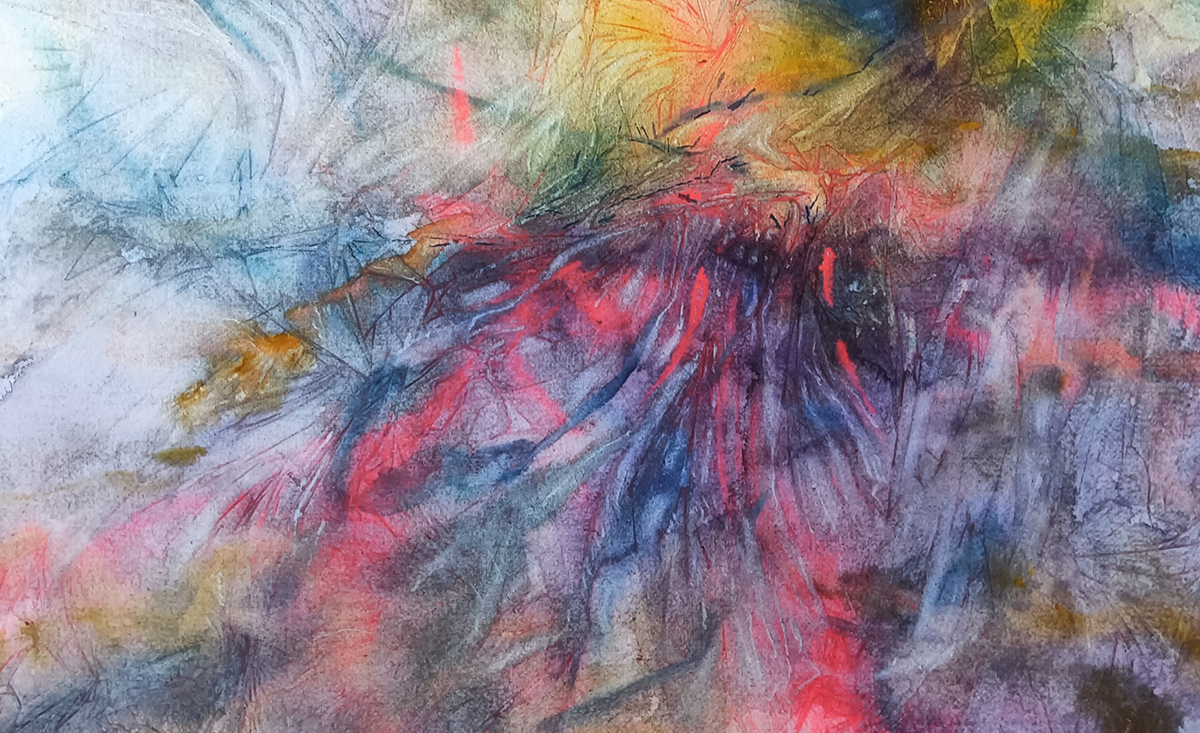
Born in Wolverhampton in 1951, David John Hilditch has developed an artistic practice in which painting and philosophy are closely connected. His work moves beyond straightforward representation, using colour, gesture, and material to examine perception, identity, and the forces that shape human experience. Rather than treating the canvas or paper as a surface on which to reproduce the visible world, Hilditch approaches it as an active space where forms can emerge, shift, and dissolve. Paint appears to take on a life of its own, moving beyond familiar boundaries of time, place, and physical definition. Through this process, the artist invites viewers to reconsider what they see and how meaning is formed. His paintings often suggest that identity is not fixed but continuously changing, influenced by energies and structures that may be felt even when they cannot be clearly named or fully understood.
Watercolor L514
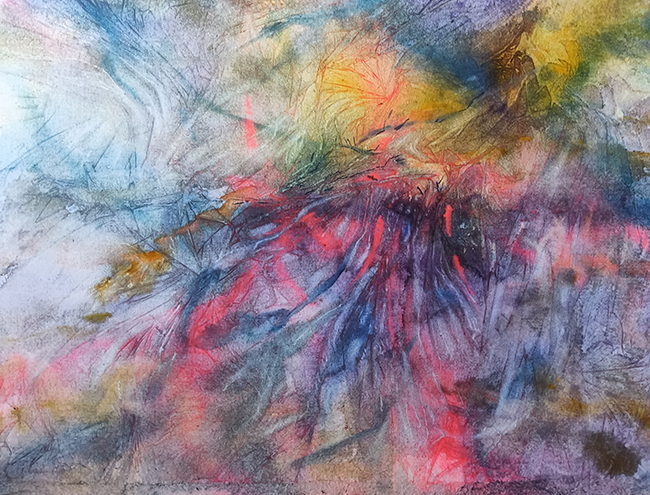
Watercolor L514, created in watercolour on Khadi paper and measuring 70 × 50 centimetres, demonstrates David Hilditch’s willingness to reconsider familiar ideas through a different medium. Although oil paint remains his preferred material, watercolour offers him another way to investigate universal structures and forces. Its transparency, fluidity, and responsiveness allow ideas to develop through movement rather than complete control.
Watercolour behaves differently from oil paint. It spreads rapidly, settles into the texture of the paper, and creates transitions that cannot always be predicted. For Hilditch, these characteristics are not limitations. Instead, they become part of the conceptual foundation of the work. The medium introduces chance into the painting process, allowing water, pigment, gravity, and the absorbency of the paper to participate in the final result.
Khadi paper is especially important to this relationship. Traditionally handmade and naturally textured, it receives pigment in ways that can produce both delicate variations and concentrated areas of colour. Its irregular surface gives the painting a physical presence, while its absorbency encourages the watercolour to move, collect, and change. The material is therefore not simply a neutral background. It actively influences the development of the image.
The title Watercolor L514 avoids providing a narrative or descriptive explanation. Its coded quality directs attention back to the painting itself, encouraging viewers to experience the work without being guided toward a particular subject. This openness reflects Hilditch’s broader interest in perception. Meaning is not presented as something complete or permanent. It develops through the encounter between the artwork and the person viewing it.
The painting can be understood as an exploration of structures that exist beyond individual objects. These may include natural rhythms, physical energies, systems of growth, or patterns of transformation. Hilditch does not necessarily illustrate these forces directly. Instead, he creates conditions in which they can be suggested through the interaction of water, colour, surface, and gesture. The work becomes a visual field where different elements meet, separate, and reorganize themselves.
This approach also raises questions about artistic control. Every painting involves decisions, but watercolour makes the boundary between intention and accident especially visible. A mark may begin as a deliberate gesture and then change as the pigment travels across the damp paper. Edges may soften, colours may merge, and unexpected forms may appear. Hilditch works within this uncertainty, responding to what develops rather than forcing every element toward a predetermined result.
In this sense, the painting process becomes similar to philosophical inquiry. Both begin with a direction but remain open to discovery. Instead of delivering a single answer, Watercolor L514 creates a space for observation and reflection. The viewer is invited to consider how order emerges from fluidity and how apparently spontaneous marks may reveal an underlying sense of structure.
The work also extends Hilditch’s investigation of identity. Just as watercolour forms are continually altered by their surroundings, personal identity may be understood as something shaped through relationships, memories, experiences, and changing circumstances. Nothing exists in complete isolation. Each element responds to another, forming a temporary balance that may shift again.
By approaching his recurring ideas through watercolour, Hilditch gains a new perspective on subjects previously explored in oil. The lighter and more immediate nature of the medium allows him to examine transformation with particular sensitivity. Pigment can appear suspended, as though it is still becoming rather than settling into a final state.
Watercolor L514 ultimately reflects an artistic practice grounded in curiosity. Through its combination of deliberate action and natural movement, the work asks viewers to look beyond recognizable imagery and engage with painting as an evolving event. It presents colour and material not merely as tools, but as active forces capable of expressing uncertainty, connection, and continual change.
