

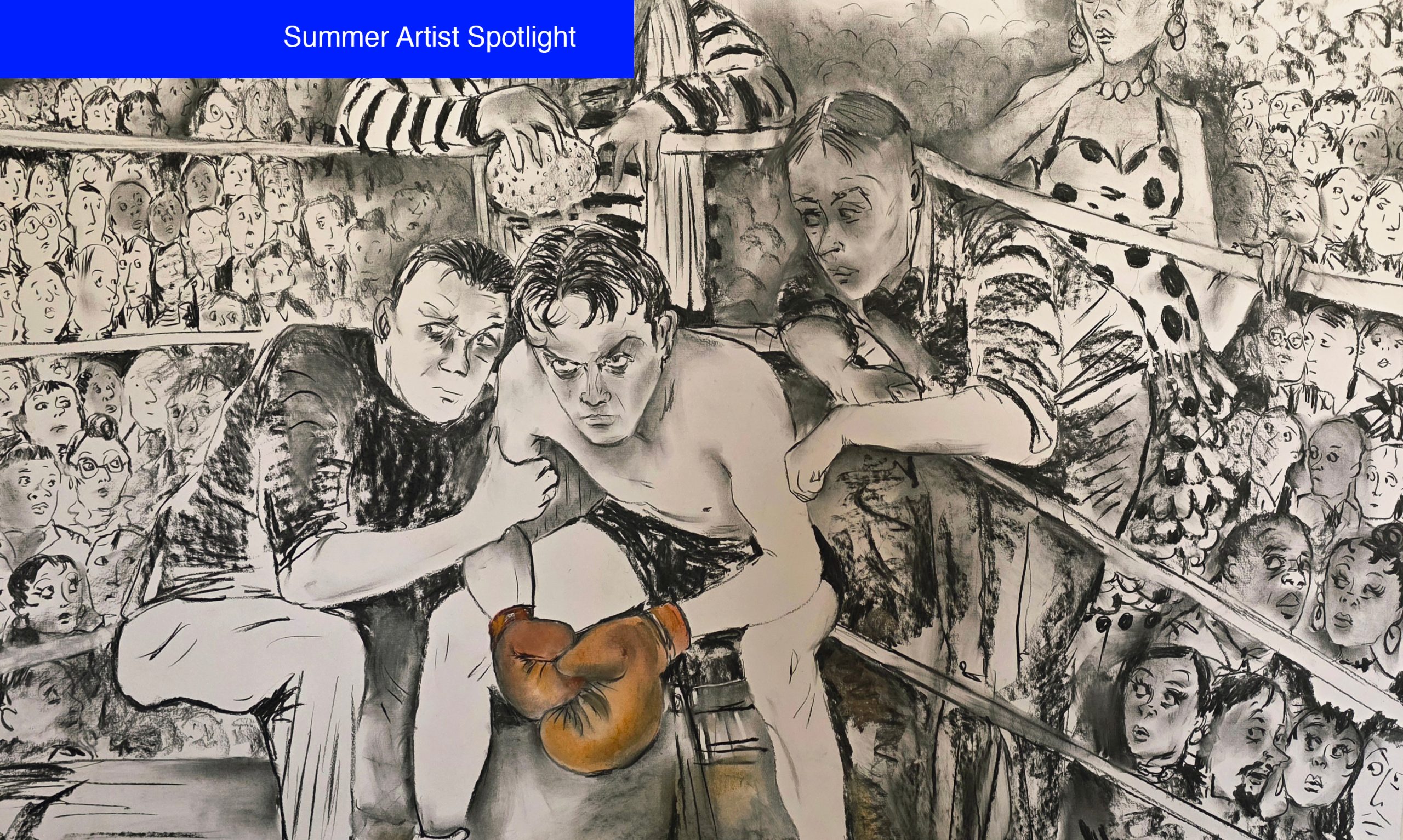
Anna Mazzotta follows observation and instinct rather than temporary artistic trends. She takes in the people, places, and moods surrounding her, then reshapes them through drawing and painting. Born in the United Kingdom and influenced by her Italian heritage, she divides her time between London and Bristol. The energy of these cities enters her work alongside references to history, identity, performance, and human behavior.
Although her studies at the Royal College of Art gave her a strong technical foundation, the personality of her work extends beyond academic training. Her portraits evoke a shadowy theatrical world filled with velvet, smoke, dramatic lighting, and emotional tension. The people she depicts are not passive models. They command the picture like performers onstage, carrying visible traces of confidence, ambition, vulnerability, and inner conflict.
“I’m So Mean, I Make Medicine Sick”
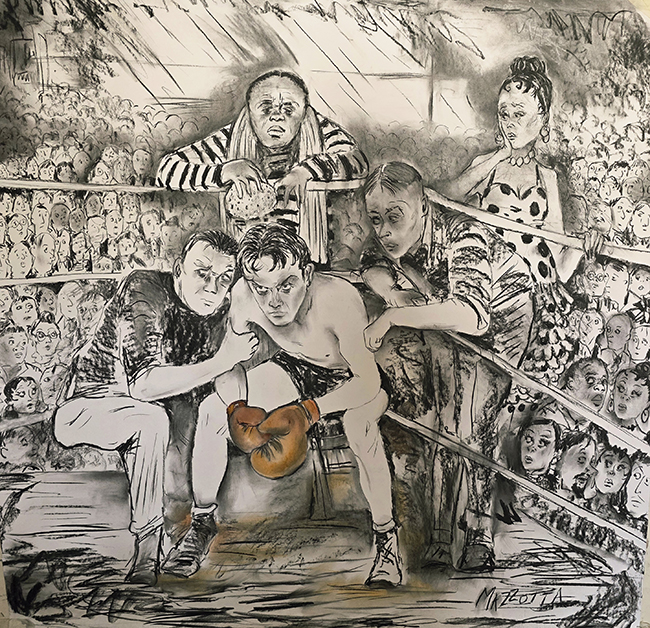
Charcoal and chalk on paper
In I’m So Mean, I Make Medicine Sick, Mazzotta focuses on Muhammad Ali, whose influence reached far beyond boxing. Ali was admired not only for his speed and skill but also for his intelligence, humor, and remarkable ability to hold the public’s attention. He delivered the line in 1974 before facing George Foreman in the historic Rumble in the Jungle. Bold, funny, and deliberately excessive, the statement captured the unforgettable character Ali presented to the world.
His words were never simply entertainment. Ali recognized that an opponent could be challenged mentally before the physical contest began. Through interviews, predictions, jokes, and poetic insults, he created pressure and established control over the story of each fight. His public appearances became an extension of his boxing strategy, turning athletic competition into a psychological and cultural spectacle.
By using Ali’s declaration as the title, Mazzotta draws attention to this combination of sport and performance. Ali becomes more than a boxer within the portrait. He is an actor, storyteller, and architect of his own public identity. His voice, facial expressions, gestures, and carefully timed remarks were all part of the image he created.
The use of charcoal and chalk reinforces the intensity of the subject. Charcoal produces deep, velvety shadows that suggest physical power and the darkness of the arena. It can be heavy and aggressive, but it can also be delicate, unstable, and atmospheric. Chalk brings flashes of light into the drawing, revealing selected features as though the boxer has momentarily stepped beneath a spotlight.
This visual contrast reflects the many sides of Ali’s personality. He could appear humorous one moment and threatening the next. His movements were graceful, yet his purpose was forceful. He combined charm with intimidation and theatrical confidence with strategic discipline. By limiting the image to charcoal and chalk, Mazzotta allows these tensions to emerge through tone, gesture, and texture.
The materials also give the portrait a strong sense of immediacy. Smudged areas create movement and atmosphere, while sharper lines suggest quick decisions and sudden physical action. The figure may be captured in a single moment, but the marks imply that he could shift, strike, or step away at any second.
Ali’s quotation gives the portrait an additional dimension. The viewer is encouraged to hear his unmistakable voice while looking at his image. The title becomes part of the experience of the artwork, connecting the visible figure with the language that helped shape his legendary status.
“Why Waltz with a Guy for 10 Rounds If You Can Knock Him Out in One?”
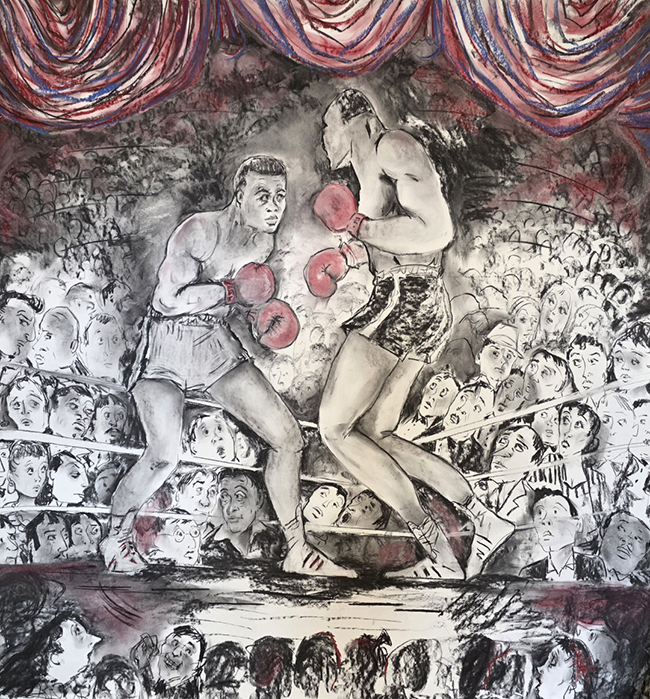
Charcoal and chalk on paper
Mazzotta’s representation of Rocky Marciano reveals a contrasting form of determination. The title, Why Waltz with a Guy for 10 Rounds If You Can Knock Him Out in One?, reflects Marciano’s straightforward philosophy. While Ali’s statement relies on humor, exaggeration, and showmanship, Marciano’s words are brief, practical, and severe. They express a preference for completing the task with maximum efficiency.
The comparison between boxing and a waltz is particularly striking. A dance and a fight may appear completely opposed, yet each depends on rhythm, balance, timing, footwork, and an understanding of another person’s movements. Both participants must control distance and anticipate what will happen next. Marciano’s remark acknowledges this relationship while refusing its elegance. He sees no reason to continue the exchange when one decisive blow can end it.
Charcoal and chalk offer Mazzotta an effective way to communicate Marciano’s concentrated power. Dark tonal areas create solidity and psychological weight, while highlights emphasize the fighter’s expression, physical tension, and alertness. Rough marks suggest instinct and impact, while more controlled passages reflect the discipline developed through training.
These changes in texture mirror the fighter’s condition in the ring. A boxer must remain controlled while being prepared to react immediately. Technique and instinct cannot be separated. Mazzotta captures this balance by allowing precision and raw energy to exist together within the same image.
When considered as a pair, the portraits reveal two different approaches to authority. Ali gains power through charisma, language, movement, and psychological strategy. Marciano represents persistence, restraint, endurance, and direct action. Their personalities differ greatly, but both demonstrate that boxing is as mental as it is physical. Victory depends upon preparation, timing, confidence, and the ability to understand an opponent.
Mazzotta does not present Ali and Marciano merely as famous sportsmen. Their quotations allow them to represent broader attitudes toward conflict, ambition, and self-belief. Ali expands the drama through words and personality, while Marciano concentrates all attention on the fastest possible result.
In Mazzotta’s expressive world, the boxing arena resembles a theatre. The ring becomes a stage, and each fighter creates a character through movement, posture, facial expression, and speech. Charcoal provides the surrounding darkness, while chalk recalls the bright lights directed toward the center of the action.
These portraits ultimately reach beyond the subject of boxing. They explore the different ways people confront danger, pressure, and uncertainty. Through her forceful materials and dramatic atmosphere, Mazzotta presents the fighter as a competitor, performer, tactician, and enduring symbol of courage.
