

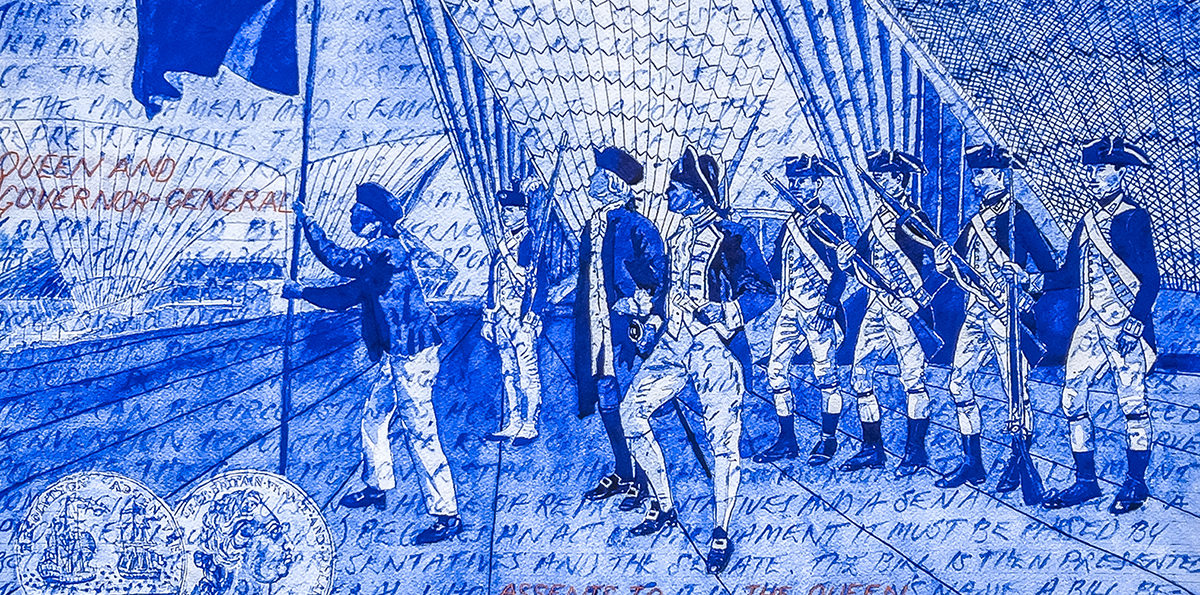
Born in Innisfail, Queensland, Sebastian Di Mauro is an Australian contemporary artist whose career spans more than three decades. Working between Brisbane and the United States, he has presented over 45 solo exhibitions and participated in more than 100 group exhibitions internationally. His multidisciplinary practice encompasses painting, sculpture, textiles, installation, and artist books, exploring the relationships between cultural identity, historical memory, and the environment.
His works are represented in prominent Australian collections, including the Queensland Art Gallery | Gallery of Modern Art and the Art Gallery of Western Australia. Significant exhibitions include GREENBACK (2019), Always and Altered, and Unsettled Ground (2026). His work was also featured in Venice in 2022, alongside the 59th Venice Biennale. His forthcoming exhibition, Catching Stars, opens at the Australian Embassy in Washington, DC, in April 2027. Di Mauro is an Adjunct Associate Professor at Griffith University’s Queensland College of Art.
Bound (2025): Examining Colonial History Through Art and Symbolism
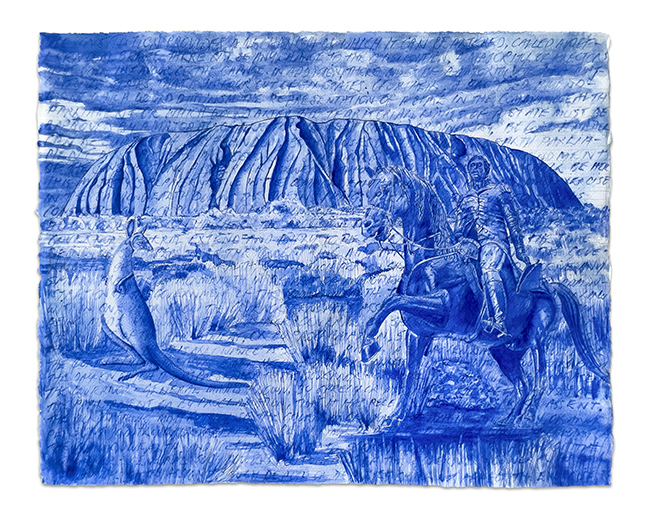
In Bound (2025), Sebastian Di Mauro explores the complexities of colonial history, cultural representation, and the relationship between power and place. Created in watercolor on Arches paper, measuring 16 × 20 inches, the artwork brings together three seemingly unrelated subjects: a kangaroo, an equestrian statue of King George III, and the sacred Australian landscape of Uluru. Through this unexpected combination, Di Mauro constructs a compelling visual narrative that questions how history has been recorded, interpreted, and imposed upon the land.
Rendered predominantly in striking shades of blue, the composition resembles an archival illustration or historical manuscript. Layers of handwritten text intersect with carefully rendered figures and landscape elements, creating an atmosphere of memory and historical reflection. The monochromatic palette establishes visual unity while suggesting the distance between historical documentation and lived experience.
On the left side of the composition stands a kangaroo, its unusual posture immediately drawing attention. The animal is based on an early European depiction by British painter George Stubbs, whose representation of Australian wildlife reflected the limited understanding of distant territories during the eighteenth century. By revisiting this image, Di Mauro highlights how unfamiliar environments were frequently interpreted through European assumptions rather than direct cultural or geographical knowledge.
The kangaroo becomes a symbol of colonial misrepresentation, illustrating how images can shape perceptions of places and identities. Its somewhat unnatural appearance suggests the limitations of historical observation and raises questions about the authority of representations that become accepted as truth.
Positioned opposite the kangaroo is an equestrian statue of King George III, modelled after the bronze monument originally located in Pall Mall, London. The commanding figure represents British imperial authority and the political influence that shaped Australia’s colonial history. Yet within Di Mauro’s composition, the monument appears disconnected from its surroundings, creating a striking contrast between imported symbols of power and the landscape they occupy.
The statue’s placement within Uluru is particularly significant. As a sacred site deeply connected to the traditions and cultural identity of the Anangu people, Uluru carries meanings that extend far beyond its physical presence. Its inclusion challenges the assumption that colonial authority could redefine a landscape already embedded with generations of Indigenous knowledge, spiritual connections, and cultural history.
Di Mauro uses this visual contradiction to examine the tension between imposed political structures and enduring cultural identities. While the monument suggests dominance and control, Uluru’s monumental presence communicates continuity, resilience, and a deeper relationship with the land.
The handwritten passages woven throughout the composition introduce another layer of interpretation. Resembling fragments of historical documents or personal reflections, these marks suggest the complicated process through which history is preserved and communicated. Their overlapping arrangement creates a sense of accumulated narratives, encouraging viewers to consider which voices have shaped conventional historical accounts and which perspectives have remained marginalised.
The expressive blue watercolor technique also contributes to the artwork’s emotional atmosphere. Variations in tone, texture, and line create depth while maintaining the appearance of an aged document. This distinctive treatment connects the visual imagery with broader questions about memory, authenticity, and the construction of historical knowledge.
Rather than presenting a straightforward criticism of colonialism, Di Mauro invites viewers to examine the contradictions embedded within familiar cultural symbols. The kangaroo, the royal monument, and Uluru each represent different relationships to Australia, revealing the tensions between observation, occupation, and belonging.
Ultimately, Bound demonstrates Di Mauro’s ability to transform historical references into a contemporary artistic dialogue. By combining symbolic imagery with expressive mark-making, he encourages reflection on cultural identity, colonial inheritance, and the enduring significance of Indigenous presence.
Through its layered composition and thoughtful symbolism, Bound reminds viewers that history is never simply a collection of established facts. It is also shaped by interpretation, representation, and the perspectives of those who possess the power to tell its stories.
