

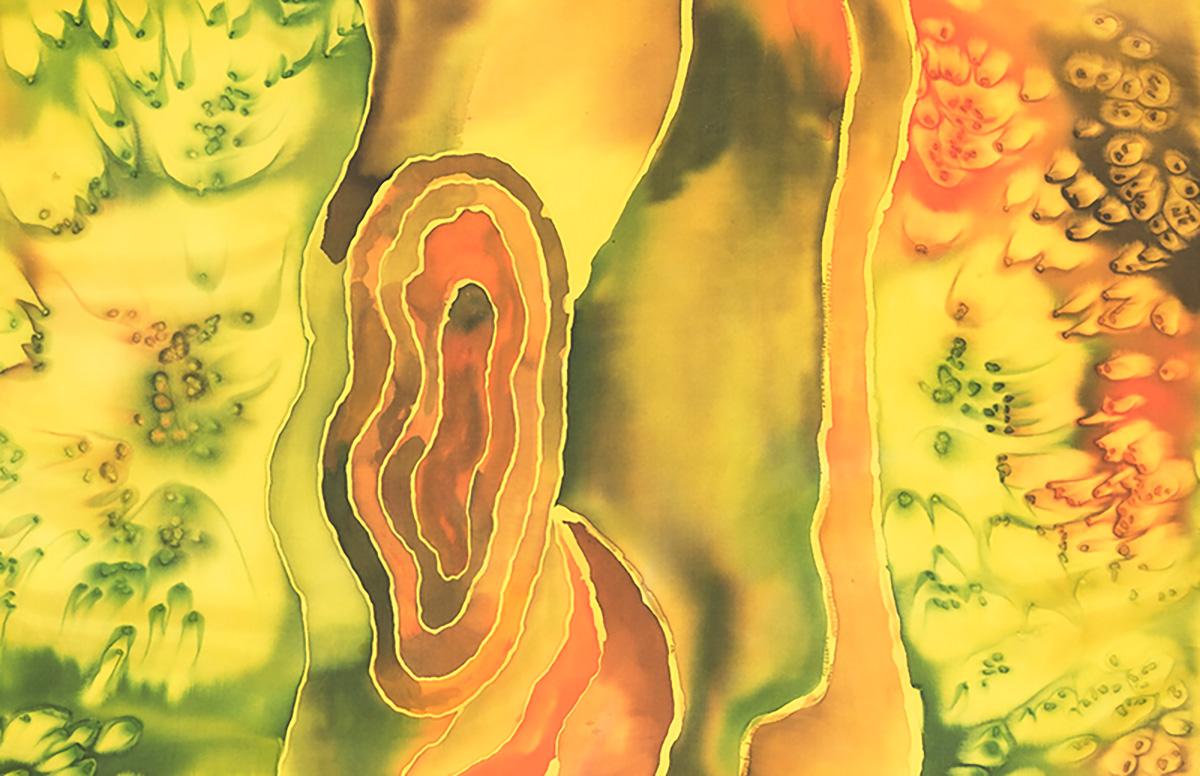
The artistic practice of Canberra-based Kirandeep Grewal is rooted in an exploration of personal history, cultural influences, and the relationship between individuals and their surroundings. Drawing upon her Indian heritage and experiences of living in Australia, she creates works that examine the many ways people develop their identities through encounters with different places, traditions, and communities. Her paintings combine personal reflection with symbolic imagery, offering perspectives on adaptation, emotional strength, and the search for belonging.
Grewal’s background as an artist and educator contributes to her interest in the communicative possibilities of visual expression. She approaches painting as a means of sharing experiences that may resonate across cultural differences. Family memories, natural landscapes, and significant moments of personal change become recurring subjects, allowing her to investigate how the past continues to influence the present while new experiences shape an individual’s outlook.
Migration (2017)
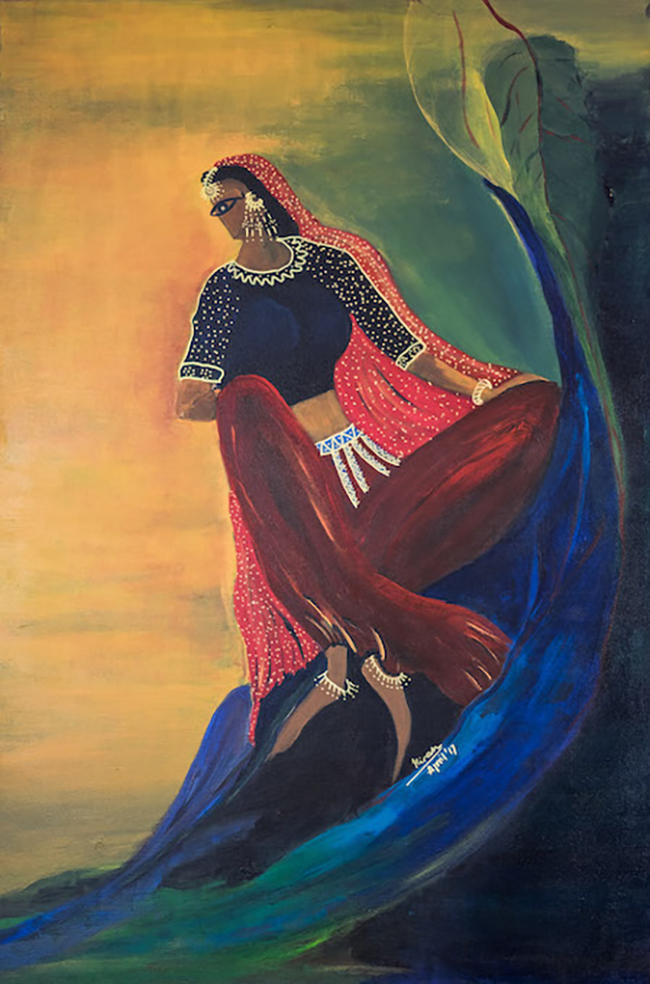
Acrylics on canvas, 92 × 61 cm
Questions of identity and displacement are central to Migration, a self-portrait through which Grewal considers the experience of establishing a home beyond the country of one’s birth. The artwork examines the emotional adjustments involved in entering an unfamiliar society while retaining meaningful ties to family history and cultural traditions.
Moving to another country can fundamentally alter everyday life. Established routines are replaced by new surroundings, relationships must be maintained across distances, and individuals often discover qualities within themselves that previously remained unexplored. Grewal considers these experiences as part of a larger process of personal transformation, acknowledging both the difficulties and the possibilities that accompany relocation.
The inclusion of traditional garments and jewellery establishes a visible connection to her ancestral background. These cultural references evoke the customs and family values that have influenced her upbringing. Rather than treating heritage as something left behind, Grewal presents it as a continuing presence that informs her understanding of herself.
Another dimension of the painting concerns the changing relationships between migrants and the people they leave behind. While physical separation may not diminish affection, the passage of time creates different experiences for those living in separate places. Familiar connections evolve as individuals encounter new circumstances, perspectives, and responsibilities.
The memory of Grewal’s great-grandmother adds a deeply personal element to the work. Her ancestor’s determination, dignity, and life experiences continue to inspire the artist, providing a meaningful link between generations. Through this connection, Grewal acknowledges the importance of inherited wisdom in navigating unfamiliar situations.
Migration ultimately considers the possibility of belonging to more than one cultural environment. It presents relocation as a journey through which individuals develop new understandings of themselves while carrying forward the memories and traditions that remain important to their lives.
Mayura on the Waterfall (2018)
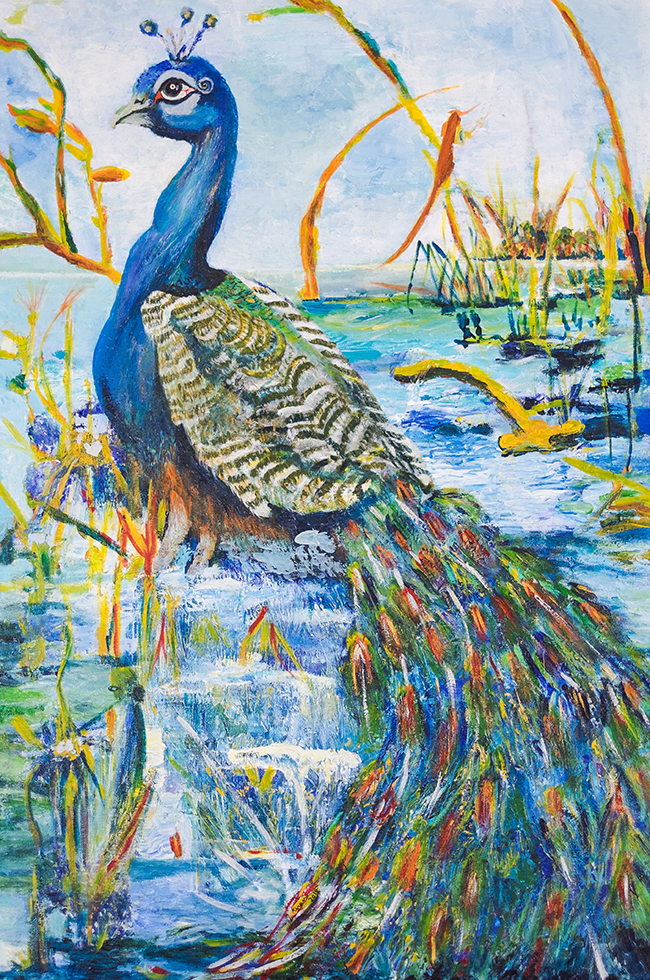
Acrylics on canvas, 61 × 92 cm
In Mayura on the Waterfall, Grewal uses the interaction between a peacock and a flowing waterfall to examine how individuals respond to the uncertainties of existence. The painting presents a moment of apparent tranquillity, with the bird resting confidently upon rocks as water continues to move through the surrounding landscape.
The peacock functions as an image of confidence and dignity. Its composed appearance suggests an inner assurance that remains intact despite changes in its environment. Grewal uses the bird’s presence to communicate the importance of maintaining emotional stability when circumstances become unpredictable.
The waterfall offers a contrasting representation of constant movement. Its flowing currents suggest the passage of time, unexpected developments, and the natural progression of life’s experiences. Water follows its course without remaining fixed, reflecting the continual adjustments required throughout human existence.
By bringing these contrasting forms together, Grewal creates a visual relationship between steadiness and transformation. The peacock’s calm posture suggests that uncertainty does not necessarily require fear or resistance. Instead, individuals may find strength in accepting change while remaining confident in their ability to respond.
The bird’s forward-facing gaze introduces an additional sense of possibility. It suggests an openness toward what lies ahead rather than an attachment to circumstances that can no longer be changed.
Through this natural imagery, Grewal considers resilience as a quality expressed through patience, adaptability, and emotional awareness. Mayura on the Waterfall encourages reflection on the value of maintaining perspective during challenging moments, presenting the natural world as a source of insight into human experience.
Gum Tree (2015)
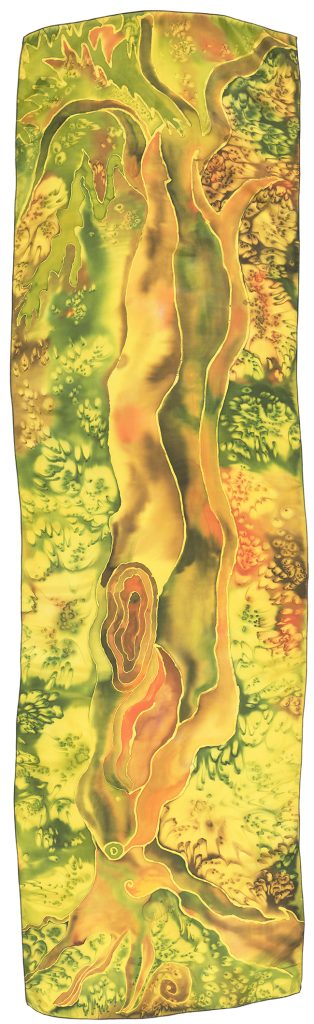
Silk dyes on Indian silk, 54 × 200 cm
The distinctive vegetation of Australia provides the subject for Grewal’s Gum Tree, a silk wall hanging that reflects her appreciation for the landscape of her adopted country. Created using silk dyes on Indian silk, the work brings together materials associated with her cultural origins and imagery drawn from her Australian surroundings.
The gum tree holds particular significance as a familiar feature of the Australian environment. Through its representation, Grewal expresses her growing relationship with the country’s natural beauty and biodiversity. The artwork reflects the emotional connection that can develop as an unfamiliar landscape gradually becomes part of one’s sense of home.
Her appreciation extends to the knowledge and traditions of Aboriginal peoples, particularly their longstanding connections with Country. These relationships highlight the importance of understanding the natural environment through respect, responsibility, and awareness of the interdependence between people and land.
The use of Indian silk gives the composition an additional cultural dimension. By selecting a material connected to her heritage, Grewal establishes a relationship between her ancestral background and her experiences in Australia. The combination suggests that different cultural influences can coexist within a single artistic identity.
The work’s elongated vertical format complements the tree’s natural form, creating a distinctive presentation that emphasises its presence within the composition. Through the expressive qualities of silk dyes, Grewal transforms a botanical subject into a personal reflection on place and belonging.
Considered together, Migration, Mayura on the Waterfall, and Gum Tree reveal an artistic vision shaped by cultural memory, personal development, and environmental appreciation. Grewal’s work invites audiences to reflect on how inherited traditions, changing circumstances, and meaningful encounters with nature contribute to the ongoing formation of identity.
