

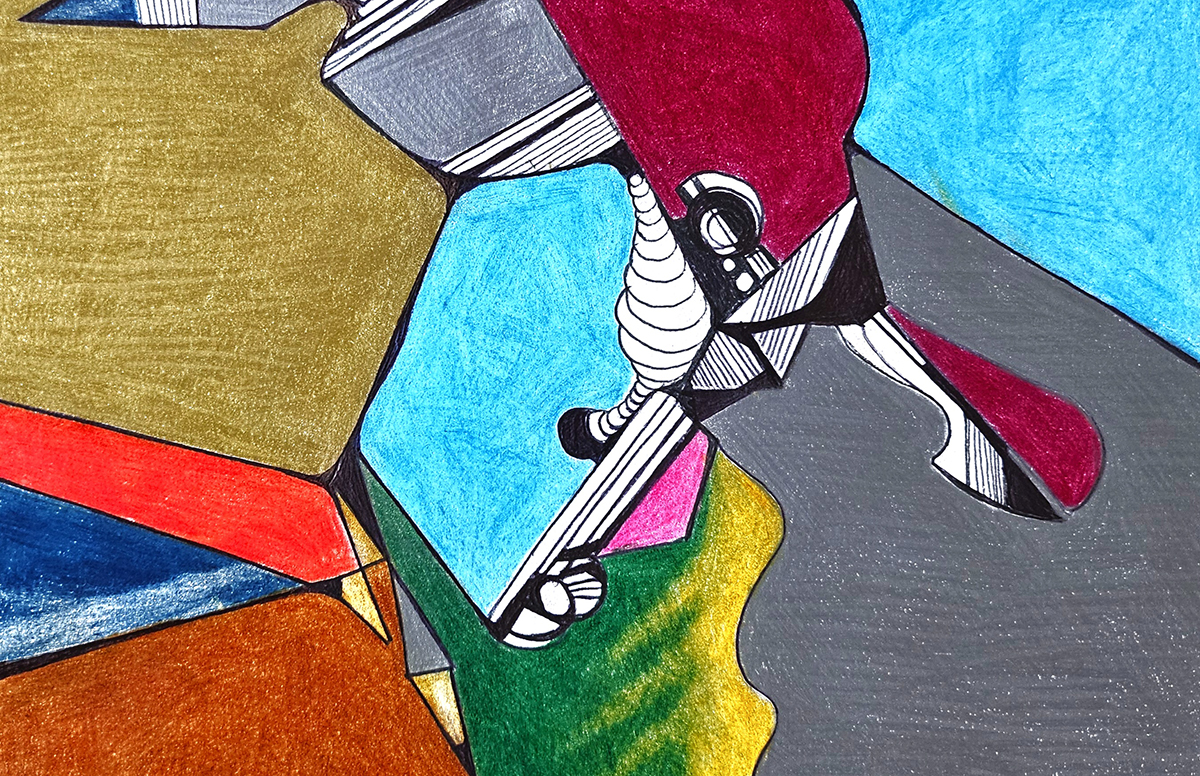
Mike Garibay explores the relationship between color, gesture, and emotion through an artistic practice that moves freely between abstraction and representation. Using oil paint and oil pastels, he creates works ranging from expansive canvases to smaller compositions on panels. His abstract pieces are built through instinctive marks and unexpected shapes, yet each element contributes to a carefully balanced visual rhythm.
Garibay also creates detailed portraits that reveal a different aspect of his abilities. These works require close observation and precision, providing a contrast to the spontaneity found in his abstract compositions. His mural projects extend his use of expressive color into architectural spaces, where scale introduces a more immersive experience.
Rather than beginning with a predetermined message, Garibay allows each artwork to develop through the creative process. Materials, colors, and gestures guide his decisions, gradually giving every composition its own emotional presence, direction, and individual character.
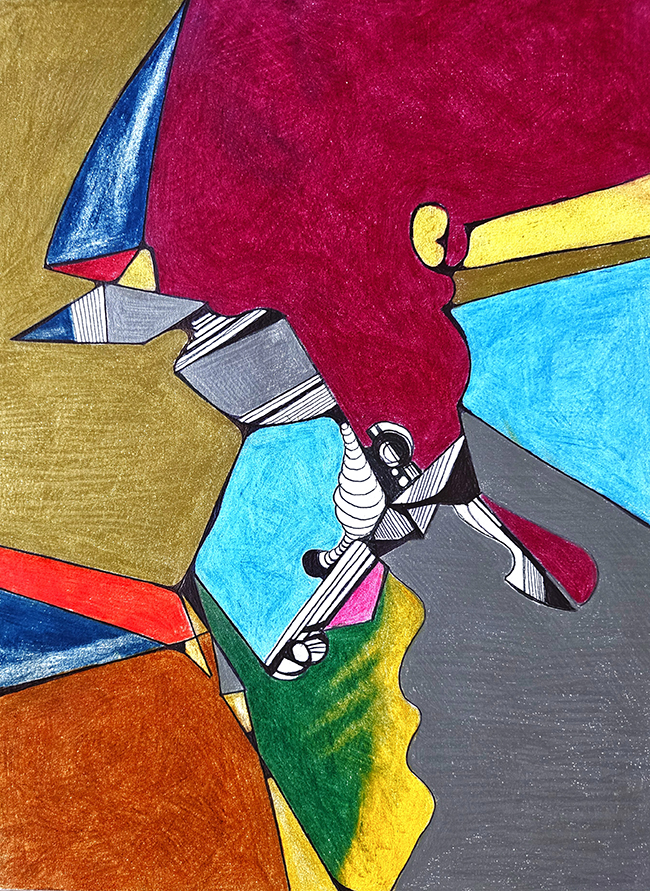
Mike Garibay’s artwork presents a dreamlike world in which bold color, abstract forms, and mechanical imagery come together to suggest a future shaped by robotics. Rather than offering a literal view of advanced technology, Garibay creates an imaginative environment where organic curves and engineered structures appear to exist side by side. The composition invites viewers to consider how human creativity, natural forms, and machines might become increasingly connected.
The artwork is organized through large areas of saturated color. Deep magenta dominates the upper center, while bright turquoise, gold, orange, green, yellow, red, and gray divide the remaining surface into distinct sections. These colors create an immediate sense of energy and establish a futuristic atmosphere. Their intensity also gives the composition the visual character of a dream, where familiar objects can become exaggerated, rearranged, or transformed into something unexpected.
At the center of the image is a complex black, white, and gray form that resembles a robotic mechanism in motion. Its narrow extensions, circular joints, striped sections, and pointed edges suggest engineered components, although its purpose remains uncertain. It could be interpreted as a machine, a futuristic vehicle, a mechanical creature, or even a robotic explorer traveling through an unfamiliar landscape. This uncertainty allows the form to exist between object and imagination.
The central structure appears to stretch diagonally across the composition, creating movement from the upper left toward the lower right. Its position gives the impression that it is flying, reaching, or navigating its way through the colored environment. A blue triangular shape near the upper left resembles a wing, fin, or sharply folded piece of metal. Below it, layered silver and striped forms introduce further mechanical associations. These details make the image feel active, as though the machine has been captured during a moment of transformation.
Garibay balances these angular elements with softer, flowing shapes. The magenta area has an irregular edge that curves around the center, while the green and yellow forms near the bottom resemble parts of a landscape or living organism. A small yellow shape near the upper right appears almost like an ear, seed, or illuminated control. Through these visual contrasts, the artwork suggests a meeting point between the natural and the artificial. Machinery does not simply enter the environment; it seems to grow from it and become part of its structure.
Black outlines play an important role throughout the piece. They separate the large color fields, clarify the mechanical details, and direct the viewer’s attention toward the center. Within the robotic form, alternating black-and-white patterns create texture and a sense of technical complexity. The repeated lines resemble wiring, segmented armor, or flexible tubing. These details introduce order and precision, while the surrounding colors remain open, expressive, and emotionally charged.
The work can also be viewed as a reflection on the uncertainty of technological progress. Its bright colors communicate excitement and possibility, yet the unusual machine remains mysterious. Viewers are not told whether it is helpful, threatening, playful, or simply curious. Garibay leaves the future open to interpretation, presenting robotics as something that may reshape how people understand movement, identity, and the boundaries between living beings and manufactured objects.
Ultimately, the artwork succeeds through its combination of color, movement, and ambiguity. Garibay does not illustrate a predictable science-fiction scene. Instead, he creates a personal vision of the future in which technology becomes part of a vibrant dream world. The result is energetic and imaginative, encouraging viewers to look beyond recognizable forms and consider what new relationships between humanity, nature, and machines may emerge.
A print edition of 100 is available on museum-quality cotton paper in a 24 × 36-inch format, allowing the artwork’s strong colors, detailed linear patterns, and futuristic forms to remain central to the viewing experience.
