
Born in Montreal in 1964, Adamo Macri studied commercial art, graphic design, photography, art history, and fine arts at Dawson College. Sculpture remains an important part of his practice, but his ideas also take shape through photography, video, painting, and drawing. Moving among these forms allows him to consider how an image changes when it is constructed, recorded, or placed in a new setting. Across his work, identity is rarely settled. A face may function as a mask; a body may seem to belong partly to its surroundings. Macri returns to figures that resist easy recognition, giving them qualities that feel human, symbolic, and invented at once. His interest lies in the moment when a familiar form begins to change, and the viewer must decide what, or whom, they are seeing.
Concrete Facade IX (2026)
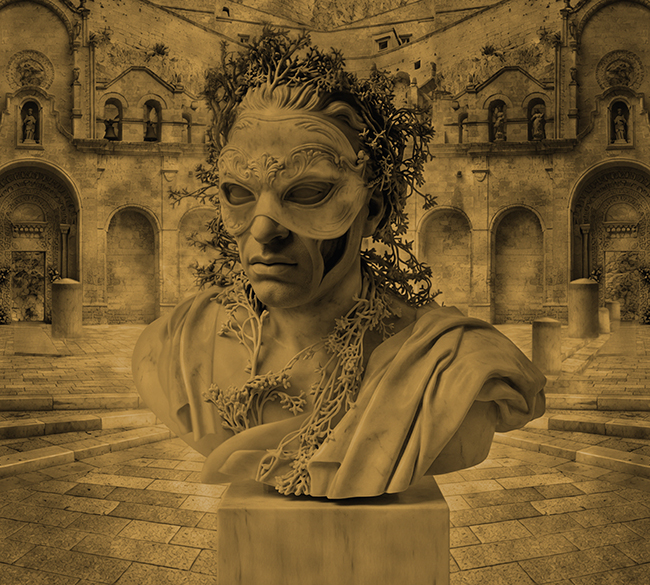
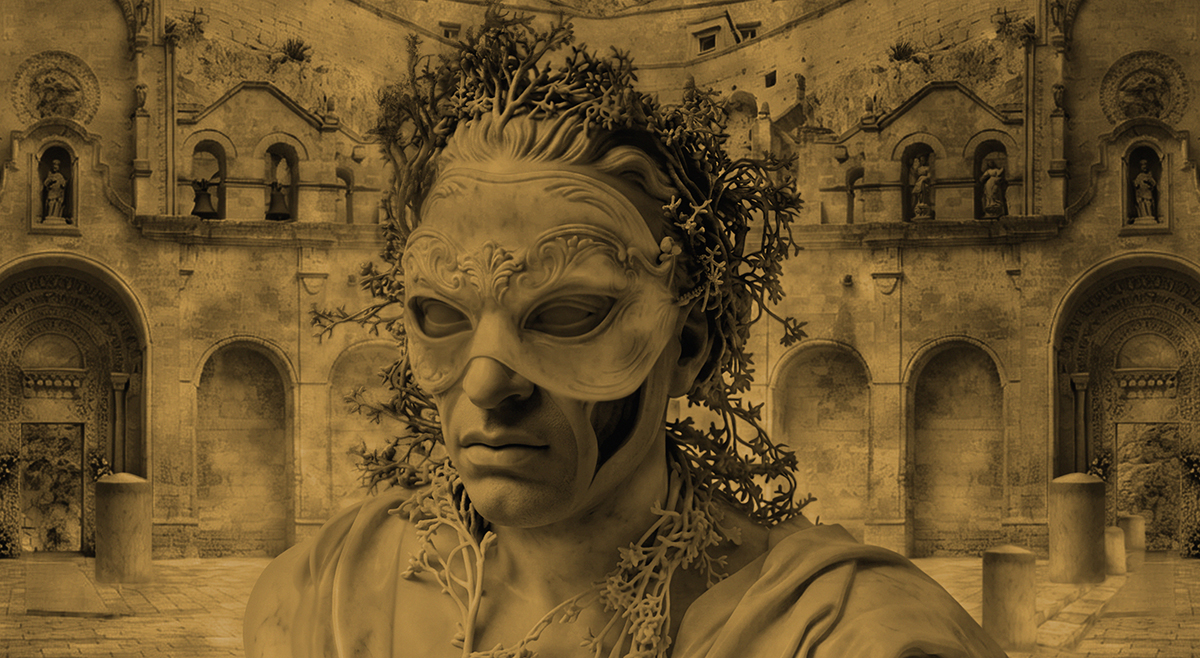
In Concrete Facade IX, Macri brings the human figure and its architectural setting into unusually close contact. The bust-like subject seems to occupy a threshold between a person and a structure. Flesh, stone, and ornament appear to press into one another, making it difficult to imagine where one ends and another begins. The figure has the presence of a monument, yet it does not feel entirely still. Its identity appears to be forming within the image.
That uncertainty changes how the facade is understood. Architecture often suggests permanence: a building preserves the choices and beliefs of the people who made it long after they are gone. A face, by comparison, is usually read for signs of individual feeling. Macri draws these two kinds of surface together. The figure seems marked by the structure around it, while the architecture takes on something of a bodily presence. Neither serves simply as the other’s backdrop.
The work’s sepia coloring deepens this connection. It gives the image the atmosphere of something remembered or uncovered, though its world remains difficult to place in a particular period. Classical references suggest a distant past, while the assembled character of the figure points toward invention. The result feels suspended between an artifact and a scene still in progress. Viewers may recognize the visual language of historical portraiture or sculpture, but the subject refuses the stable identity such traditions often promise.
Macri has described the first work in the Concrete Facade series as a digital artwork developed from architectural research, altered fragments, collage, and a reference photograph of himself. Knowing something of that process offers another way into Concrete Facade IX. Its apparent monumentality can be read alongside the acts of selection and assembly behind the series. A convincing figure emerges from parts, just as a public identity can be shaped from appearances, roles, and expectations.
The mask is central to that reading. It may conceal a person, but it can also become the means by which a person is seen. Here, the face suggests a constructed persona that cannot be peeled away to reveal a simple, unchanged self beneath it. The surrounding ornament adds to this impression. It seems to participate in the figure’s making, as though history and setting have become part of its anatomy. What looks like a portrait becomes a question about how much of a person belongs to the world that has shaped them.
There is also a creature-like quality to the subject. It occupies an uneasy place between sympathy and estrangement: recognizable enough to invite a human response, unfamiliar enough to resist it. Macri leaves that tension open. The figure can be approached as vulnerable, theatrical, or imposing, with each reading changing the meaning of the architecture around it. If the structure feels protective, it may seem to shelter the figure. If it feels restrictive, the same details can suggest a body caught within inherited forms.
The numbering of Concrete Facade IX adds another layer. Although the series page presents the first four works alongside this ninth installment, the images need not be read as a continuous story with every intervening event supplied. The gap allows IX to feel like a fragment of a larger account. It has connections to the earlier figures, yet it holds its own questions about appearance and transformation. The viewer arrives in the middle of that account and is free to imagine what has changed.
Ultimately, Concrete Facade IX does not offer a completed metamorphosis. Its force lies in keeping the process visible. The figure is at once human and architectural, old in atmosphere and newly assembled in form. Macri uses those unresolved relationships to make identity feel less like a permanent likeness than something continually made, altered, and seen anew.
According to the award information supplied for this article, Concrete Facade IX was included in the official catalog for the International Prize Renoir event held in Cannes, France, on September 12, 2026.
