

Kristina Ahmas is an artist who worked for decades inside the heart of cultural institutions before turning fully toward her studio. Her life has unfolded between scholarship and paint, research and intuition, theory and practice. Today, she paints full time, moving confidently through abstraction using a subtle palette and a deep respect for light. Her work feels like a natural continuation of everything she has studied, lived, and observed: the history of art, the language of museums, human emotion, and the silent stories held within everyday objects.
Her background sets her apart. Kristina holds an MA in art history, and later a PhD in management, a combination that reflects an unusual route into contemporary painting. She spent over twenty years as a museum director in Finland, guiding an art and cultural heritage museum and shaping its direction. That long leadership role brought her close to artworks, artists, archives, academic dialogue, and the immense structure behind art culture. She learned how artworks speak through time, how heritage is protected, and how visual culture develops through centuries of influence. The museum world gave her constant access to artistic periods, movements, and masters, and those years left a permanent imprint on her visual thinking.
Yet, despite this professional environment, Kristina had painted since childhood. She describes painting not as an occupation she chose late in life, but as something that persistently waited for her return. A few years ago, abstraction opened a new path—what she calls a discovery rather than a decision. Instead of illustrating objects, she began translating them. This shift from description to abstraction changed everything. She now works on canvas with a focus on color relationships, form, and atmospheric structure more than literal representation.
In her paintings, there are echoes of the things she observes in daily life: chairs, bottles, clotheslines, vessels, and clipped hints of the urban landscape. She is fascinated by ordinary objects and quiet surroundings, particularly those found at home, around town, or in nature. These visible triggers are starting points; once the painting begins, they dissolve into shapes, spatial tensions, and layered tones. Kristina has learned to trust the process, allowing the painting to guide progress rather than forcing strict plans. She often speaks about moments when the work begins leading her, telling her what must be done next. This relationship between artist and artwork is the core of her practice.
Light is a recurring theme. Kristina identifies herself as a colorist, but for her, color is inseparable from luminosity. She searches for tones that breathe: pale neutrals, soft blues, muted greens, quiet oranges, and earth browns that feel almost mineral. In her work, color never shouts; instead, it hums. The surfaces are layered gently, building a sense of atmosphere rather than heavy material presence.
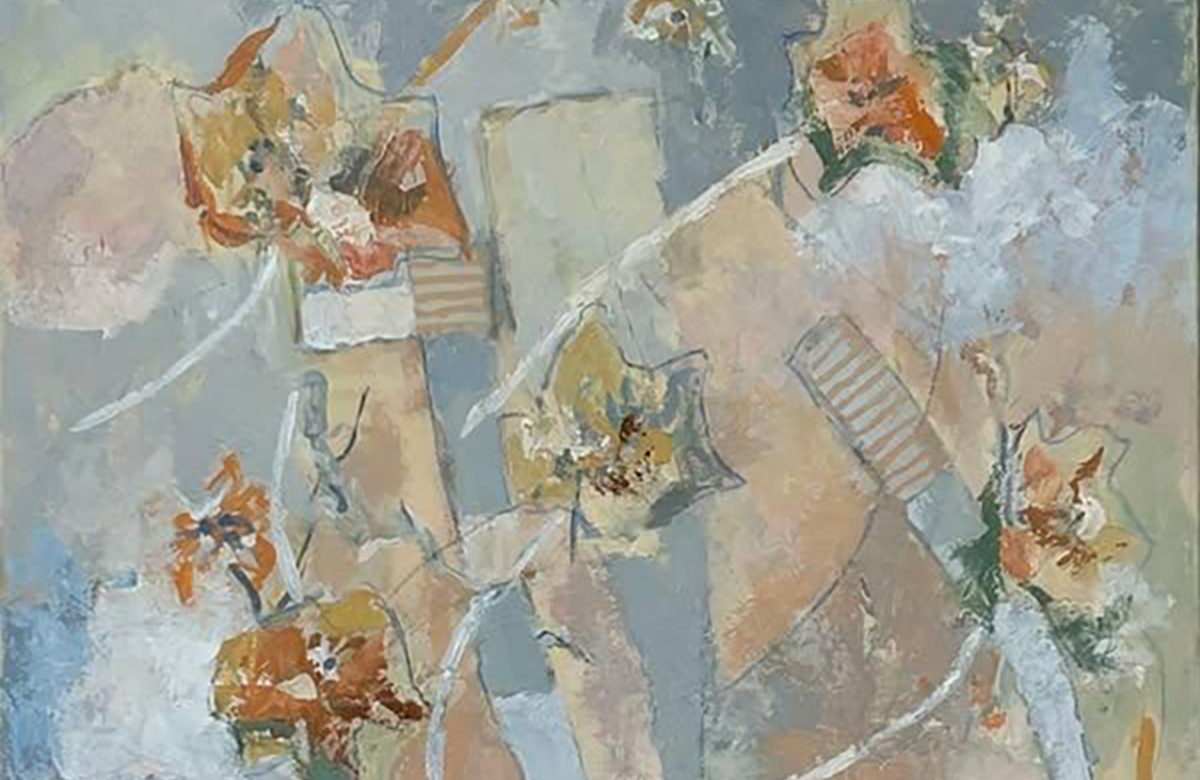
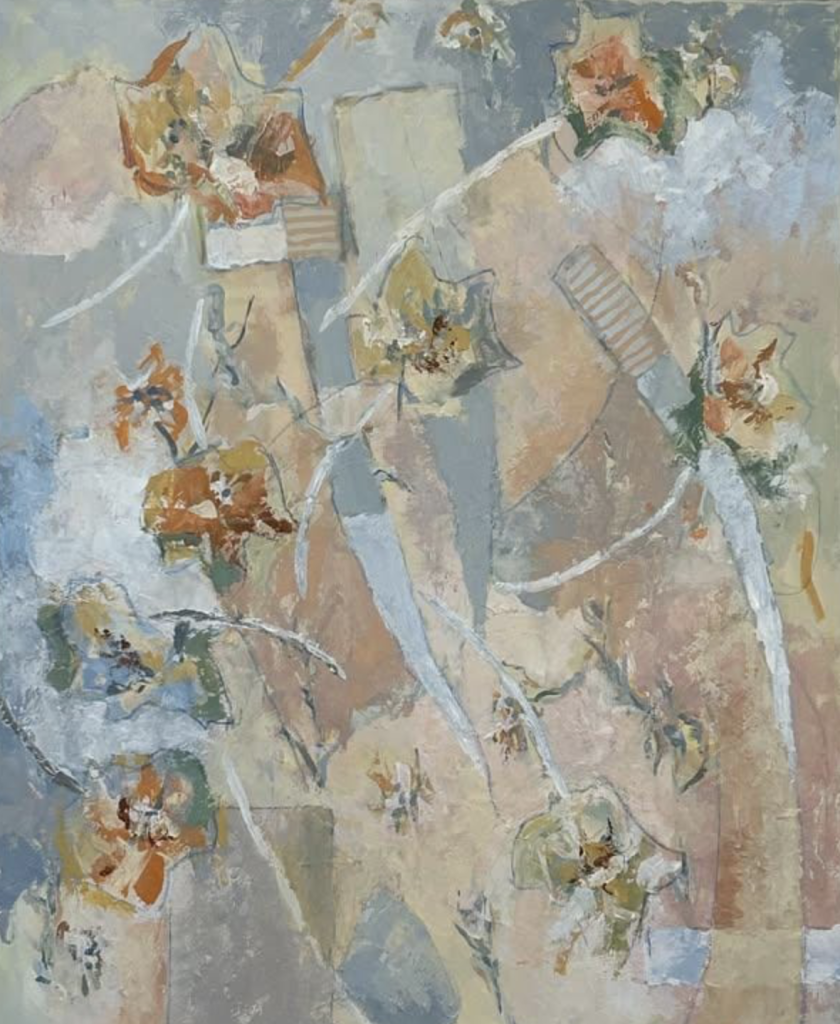
Her paintings offer a kind of aerial or suspended perspective. In the artwork shown above, loose plantlike forms stretch across a field of broken shapes. Pale peach and cool grey planes shift beneath clusters of ochre and rust flowers. Lines sweep diagonally, recalling stems or paths or internal maps. There is both movement and stillness: a drifting softness contrasted with structural edges.
This visual language feels deeply influenced by Kristina’s intellectual background. She knows painting history from the inside out: modernism, post-modernism, abstractions, color field, and countless regional movements. That knowledge fuels her confidence, but it also shapes her discipline. She sees art as a self-correcting act. Every stroke demands response, reconsideration, and honesty. She describes painting as a “merciless mirror,” one that reflects not only compositional choices but personal truth.
The way she speaks about art reveals an artist who values growth more than product. She examines her choices daily, deciding whether yesterday’s marks still hold meaning. She lets the painting transform through uncertainty, resisting the temptation to finish too quickly. In her words, art requires self-critique and vulnerability, a willingness to see the flaws and keep going anyway.
Her academic work continues around her studio life. Kristina has written several books and dozens of articles about art, architecture, and heritage. She has also contributed research to the field of museum leadership, including a PhD dissertation on collective leadership structures within museums. That research trained her to recognize cultural systems, social patterns, and human behavior in creative organizations—knowledge that now sits quietly beneath her painting practice.
Kristina’s identity as an artist is unusually complete: she understands art intellectually, historically, professionally, spiritually, and emotionally. She has spent her life in conversation with artworks—first through analysis, then through curation, and now through creation. That long journey ensures that her visual voice is her own. She does not imitate styles or trends; rather, she processes everything she has learned through the filter of her inner experience.
Her abstractions are inviting rather than cryptic. They do not hide meaning; they open it. Her subjects may begin with a chair or a coat or a landscape, but Kristina paints to remove boundaries, not reinforce them. What remains on the canvas is sensation: color memory, gesture, atmosphere, and the fleeting architecture of thought.
Kristina Ahmas paints because she must—because painting, for her, is a living practice. It is research, meditation, and a place to examine life. She works with the same curiosity and devotion that once shaped her museum career, but now the conversation is internal. The museum world taught her about heritage, but painting allows her to leave her own mark within it.
