
Mikel Frank is an experienced artist, educator, and curator who has spent his life immersed in the arts. His 29 years at The Metropolitan Museum of Art gave him an extraordinary foundation, shaping his understanding of both history and contemporary practice. Over the years, he has curated exhibitions in New York and Charlotte, NC, and his work has traveled internationally with the Global Art Project. Frank has also worked alongside some of the most ambitious art projects of the past decades, including Christo and Jeanne-Claude’s The Gates Project in Central Park. His curatorial vision was also central to MICA: Then and Now at the Noyes Museum of Art. Across all these roles, Frank has balanced his own studio practice, blending paint, line, and texture to create works that carry both immediacy and reflection. His art is often deeply personal, shaped by events that demand emotional honesty.
The Work: Israel
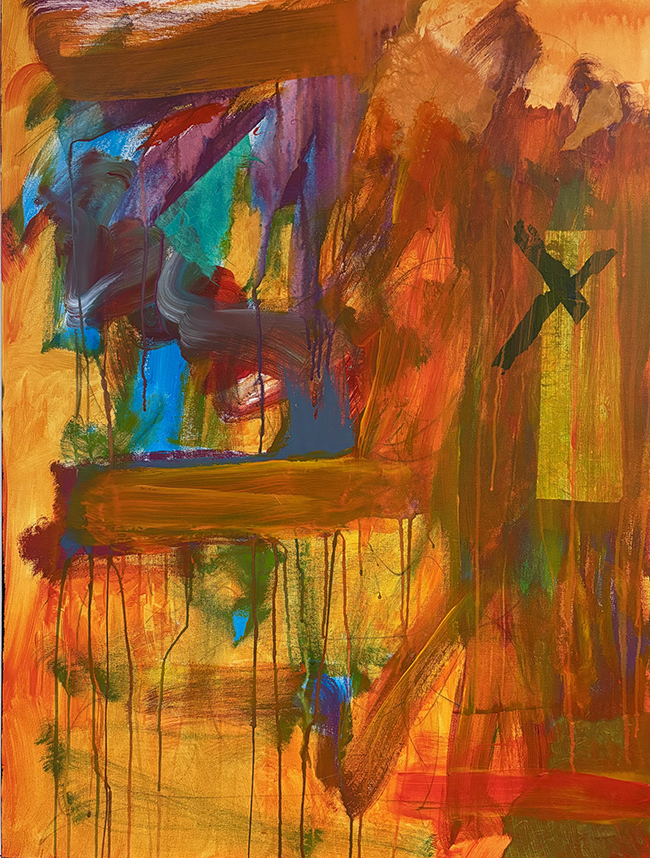
Frank’s painting Israel (acrylic, oil, pencil on canvas, 40” x 30”, 2023) was born in the middle of an artist residency at South Porch in Summerville, South Carolina. The timing was brutal: he began the piece the very week news broke of the Hamas attack on Israel. This was not a work planned in advance, nor a detached studio experiment. It was a reaction—raw, emotional, and urgent.
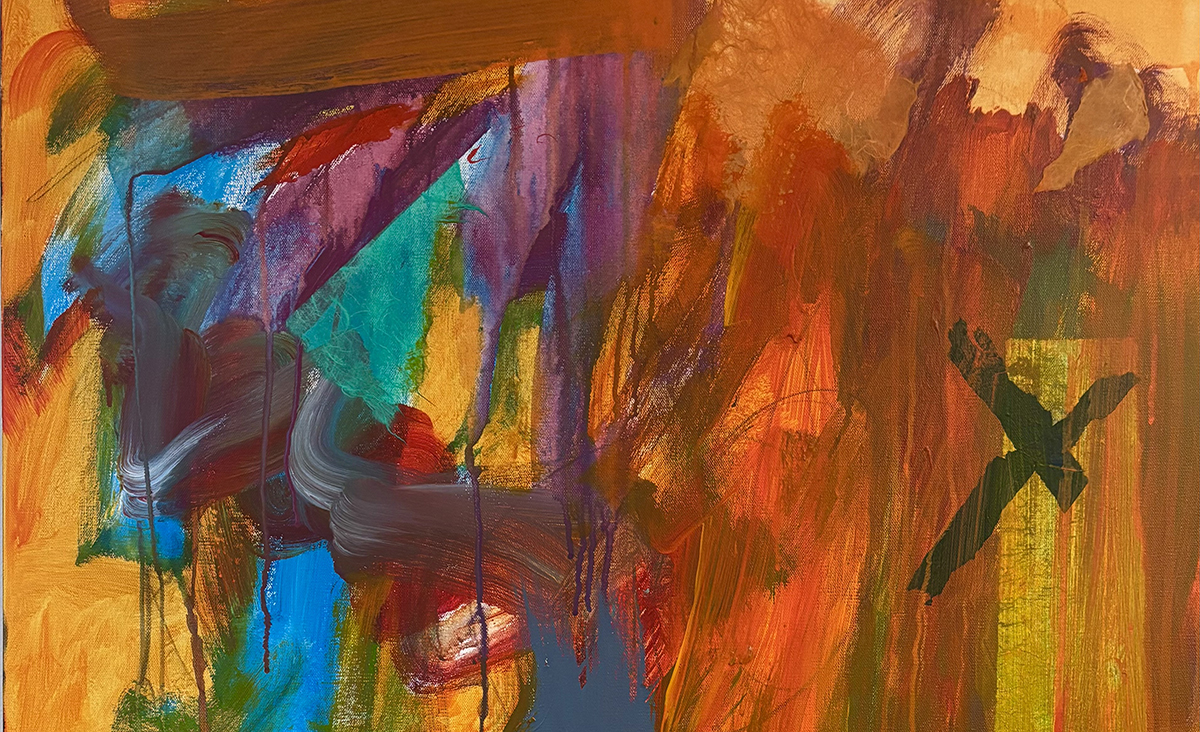
The canvas is dominated by variations of red. Not a single flat field, but layered, shifting tones: deep crimson, fiery scarlet, and shades that suggest both blood and fire. Red becomes the language of rage, grief, and helplessness. Frank makes no attempt to soften or rationalize these emotions; he allows them to spill across the surface. The viewer feels the immediacy, the way tragedy sears itself into the body and mind before words or explanations can catch up.
And yet, amid the red, there is blue. It sits in one section of the painting, a counterweight to the heat. Frank has said that this blue represents hope. It’s not large enough to dominate, nor is it hidden. It’s there, visible and deliberate, reminding us that even in moments of despair, there is space for renewal, for possibility. The contrast between red and blue is simple, but the impact is profound. It suggests that even when devastation feels total, the human spirit looks instinctively for light.
The layering of media—acrylic, oil, pencil—adds to the sense of struggle. Acrylic sets the foundation, fast and unforgiving, almost like a scream fixed onto the canvas. Oil brings richness and depth, allowing the red to breathe, to glow and darken. Pencil is sharper, immediate, and personal, like a hand-drawn note pressed into the surface. Together, these materials create tension: permanence versus impermanence, gesture versus solidity.
Israel is not a political statement in the traditional sense. It doesn’t offer solutions, nor does it argue for one side or another. Instead, it exists in the space of human response. It is about what happens inside an artist when violence enters the world. The anger is palpable, but so is the helplessness. In this way, the painting speaks to anyone who has felt powerless in the face of events larger than themselves.
Frank’s decision to leave room for hope—through that blue—transforms the piece. Without it, the painting might collapse into despair, a visual scream without release. With it, the work becomes a meditation on survival. The human need to hold onto hope, even when circumstances appear hopeless, is what gives the painting its weight.
The context of creation also matters. A residency often allows for reflection, for quiet time away from the rush of daily life. But in this case, solitude collided with world news. The residency became less a retreat and more a crucible, where Frank’s emotional state was distilled onto canvas.
In the end, Israel is a work about duality—violence and compassion, despair and hope, anger and healing. It’s a reminder that art doesn’t need to explain tragedy; sometimes it only needs to witness it, to hold space for feelings too big for language. For Frank, this was not simply another painting in his career, but a necessary act: a way to process and share what cannot otherwise be contained.
