

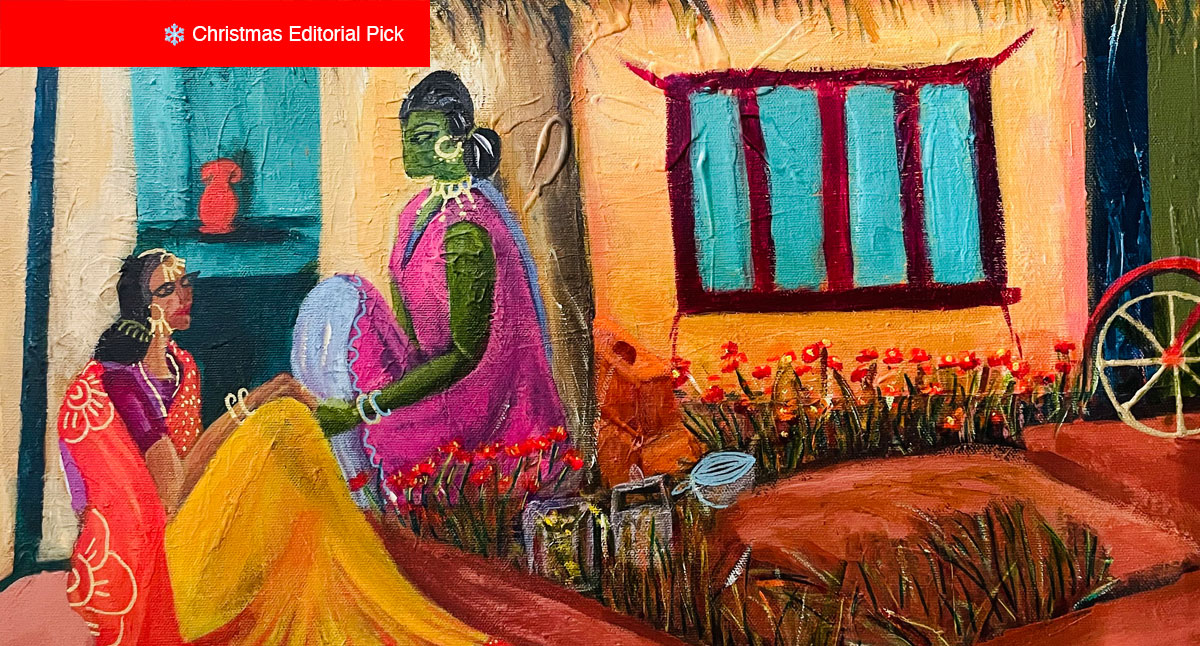
Kiran Grewal lives in that rare space where art, reflection, and human connection meet. Based in Canberra, she works with the calm steadiness of someone who knows that creativity is not separate from daily life, but threaded through it. Her practice isn’t about producing objects for display alone. It’s about telling stories, holding space, and acknowledging the people whose lives shape the world in quiet but lasting ways. Grewal often says she stands at the crossroads of art and community, and that description fits. She paints to understand herself, but she also paints to lift others. She teaches to share technique, but also to offer hope. And she moves through the art world as someone who sees every visitor, student, or passerby as part of a larger collective story.
Her journey is shaped by cultural immersion, meditation, and an ongoing curiosity about how people navigate the complexity of being human. Grewal’s art reflects that curiosity—her images tend to feel grounded, patient, and attentive. She works with acrylics, a medium that allows both immediacy and layering, mirroring the way she approaches meaning itself: one moment at a time, building toward something whole. Her paintings explore identity, resilience, and belonging without heavy symbolism or grand gestures. Instead, they speak through tone, gesture, and presence. Grewal’s work often feels like a conversation—one where nothing needs to be forced and everything has time to reveal itself.
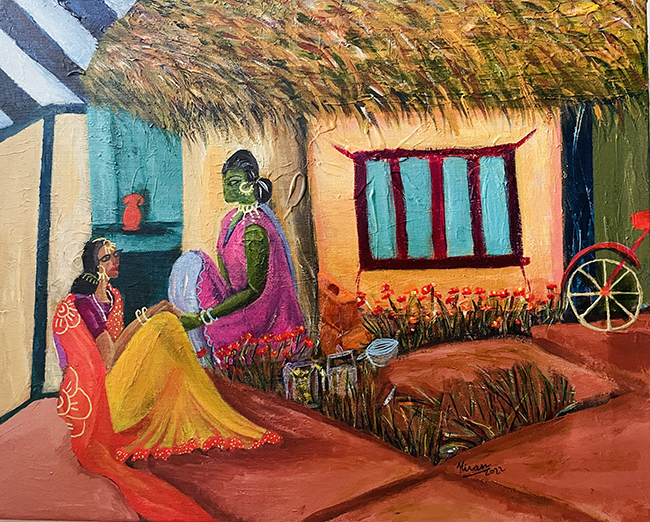
Her painting “Homage” (2023) is a good example of how she moves through ideas with clarity and care. Measuring 41 cm x 51 cm, it’s modest in scale but full in spirit. Created with acrylics, the work centers on the older women who appear in our lives daily—women we may pass on the street, learn from, overlook, or lean on. Grewal sees them as anchors. They represent strength built through decades of uneven roads, quiet sacrifices, unspoken endurance, and moments of joy that accumulate into wisdom. “Homage” is not sentimental; it’s direct. It’s a nod to the steady force that older women bring into a world that often moves too fast to acknowledge them.
In the painting, Grewal’s brushwork feels attentive, almost meditative. She paints as if she is listening. The work is a reminder that wisdom rarely enters a room with noise. It arrives through accumulated experience, through the way someone has lived and survived and adapted. Grewal has always been interested in what remains unspoken between people. “Homage” is her way of saying that the presence of these women shapes our ideals and teaches us how to walk through the world with grace. Their influence may be subtle, but it’s foundational.
Community well-being is one of the strongest threads in her story. Grewal doesn’t separate art-making from the desire to help others. Her teaching practice reflects that. Whether she’s guiding beginners or supporting people who use art as a form of healing or grounding, she approaches the work with compassion. Creativity, for her, is a stabilizing force. It builds confidence. It connects people who might otherwise feel isolated. And it gives voice to experiences that don’t always find space in daily conversation. Many of her students come to her with a simple desire to try something new. They often leave with a deeper understanding of themselves.
Grewal’s connection to meditation also shapes her work. She treats the studio almost like a quiet room where reflection takes place. She’s aware of how the mind affects the hand and how the act of painting can slow things down. Instead of chasing intensity or drama, she stays open to what unfolds naturally. This approach creates paintings that feel lived-in rather than performed. Viewers sense the honesty before they analyze anything else. Grewal trusts that sincerity will land where it needs to.
As a storyteller, she gravitates toward the everyday—the people we overlook, the emotions we manage privately, the gestures that say more than words. Her art gives these moments a place to rest. She avoids spectacle because she doesn’t need it. The stories she wants to tell already exist in real lives, in the subtle ways people show resilience, affection, or struggle. She paints not to impress but to witness.
What makes Grewal’s work resonate is the clarity of her intention. She isn’t chasing trends or proving a point. She’s documenting the emotional fiber of the world around her. “Homage” sits within that intention, offering respect without embellishment. It acknowledges older women as guides, caretakers, and carriers of generational memory. It’s a reminder that our values—how we understand strength, dignity, and compassion—come from observing those who have lived long enough to embody them.
In a time when art often leans toward spectacle, Grewal’s work is refreshing in its grounded approach. She paints slowly. She thinks deeply. She listens. And through that quiet process, she creates images that stay with you. Her art is not about the loudest moment. It’s about the meaningful one—the one you almost missed but needed.
