

Born in East London, United Kingdom, Sara Twomey is a self-taught painter whose practice has developed through independent exploration and a deep curiosity about the visual possibilities of abstraction. Free from conventional academic methods, she has cultivated a personal approach that focuses on geometry, balance, movement, and the relationships between space, light, and surface. Rather than representing familiar landscapes or figures, Twomey creates paintings that encourage contemplation through carefully arranged forms and subtle visual interactions. Her compositions are built from lines, shapes, and layered structures that shift as the viewer moves, creating an experience that feels both dynamic and reflective. Working intuitively while maintaining a strong sense of composition, she transforms simple visual elements into works that reward close observation. Through this balance of precision and experimentation, Twomey invites viewers to look beyond the obvious, discovering how abstract forms can communicate emotion, atmosphere, and a quiet sense of order.
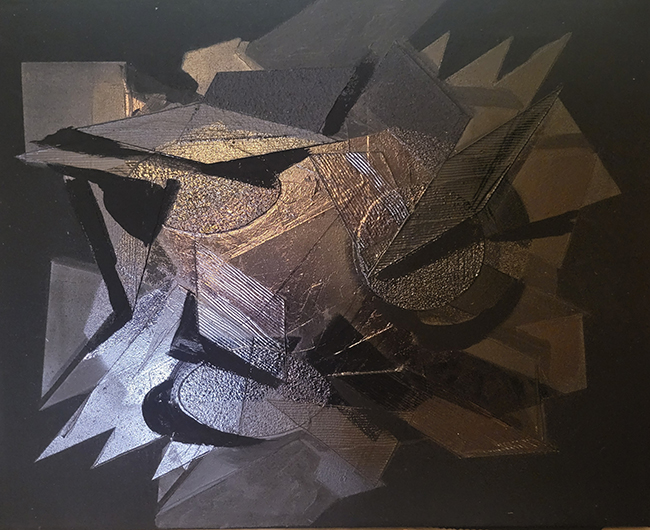
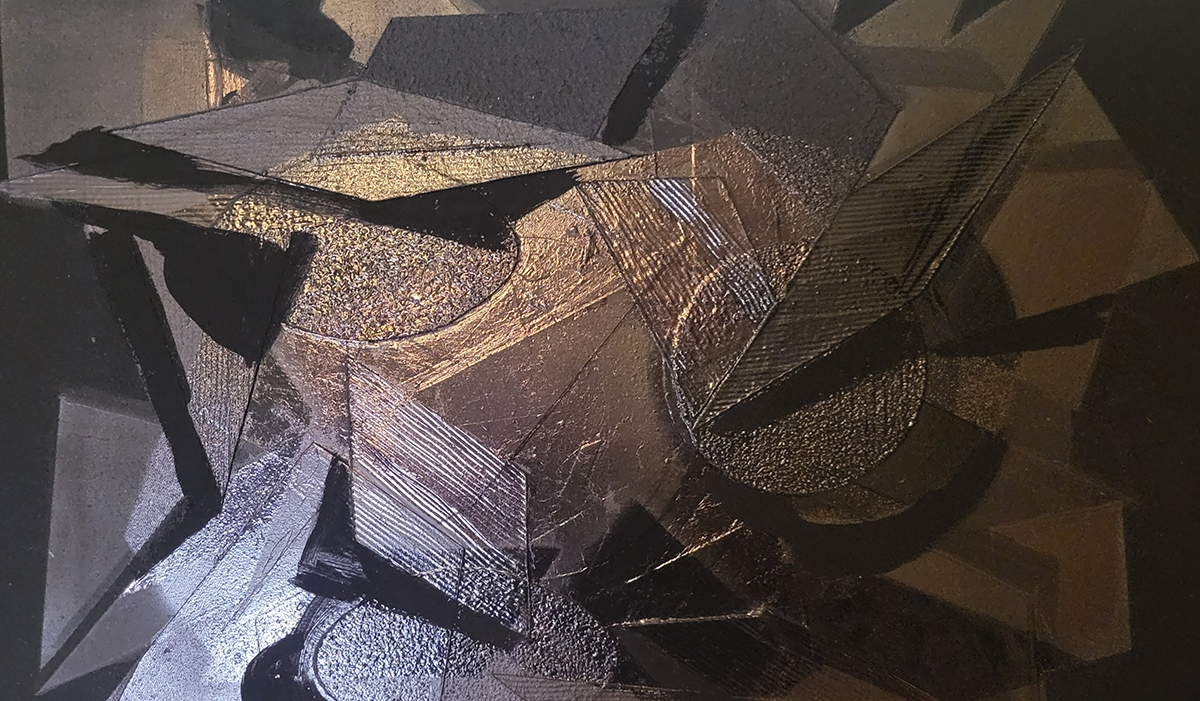
One work that captures Sara Twomey’s thoughtful approach is Closing Time, a painting that explores the relationship between light and darkness through subtle material contrasts rather than dramatic color. At first glance, the composition appears restrained, dominated by black surfaces and carefully organized geometric forms. However, the longer one spends with the painting, the more its visual complexity begins to unfold. Instead of relying on bright pigments or expressive brushwork, Twomey allows light itself to become an active participant in the work.
Black has long carried associations with mystery, silence, and depth, yet Twomey approaches it as a medium capable of revealing rather than concealing. By working with both matte and gloss black paint, she creates an image that changes according to the viewer’s position and the surrounding light. The contrast between these two finishes becomes the painting’s primary language. Matte surfaces absorb light, while glossy passages reflect it, producing subtle shifts that continually reshape the composition.
This interaction transforms the painting into something that cannot be fully understood from a single viewpoint. As viewers move through the space, reflections appear and disappear, allowing different parts of the work to emerge over time. The painting becomes an experience rather than a fixed image, encouraging slow observation instead of immediate interpretation. Twomey demonstrates that abstraction is not only about composition but also about creating an ongoing dialogue between artwork, environment, and viewer.
The title, Closing Time, introduces another layer of meaning. Rather than describing a literal scene, it suggests a transitional moment when activity gives way to stillness. Closing time often marks the end of movement and conversation, creating a pause between one experience and the next. Twomey’s painting captures this atmosphere through its restrained palette and carefully controlled geometry. The work feels calm and reflective, inviting viewers into a space where distractions fall away and attention becomes more focused.
Geometry plays an essential role throughout the composition. The structured arrangement of forms provides stability while also directing the viewer’s gaze across the painting. Lines intersect with measured precision, creating an architectural rhythm that feels deliberate without becoming rigid. The composition balances order with subtle variation, allowing each shape to contribute to the overall harmony of the work.
Rather than emphasizing texture through heavy application of paint, Twomey allows the physical properties of the surface itself to become expressive. The dialogue between matte and gloss finishes creates depth without relying on illusionistic perspective. Light appears to travel across the painting, gradually revealing hidden relationships between the geometric elements. What initially seems flat slowly develops into a layered visual field where surfaces respond differently depending on changing conditions.
The illuminated centre becomes the emotional focus of the painting. Twomey describes blocking light within the matte black dimensions until it is caught and illuminated in the centre, creating a quiet moment of revelation within the surrounding darkness. This subtle concentration of reflected light acts almost like a destination for the eye. Rather than overwhelming the composition, it emerges naturally through careful control of material and surface.
This measured approach encourages patience from the viewer. In a culture often defined by speed and instant visual impact, Closing Time rewards those willing to spend time looking. The painting does not reveal everything immediately. Instead, its shifting reflections and restrained palette gradually disclose new relationships and visual discoveries. Each viewing can feel slightly different as natural or artificial light changes throughout the day.
Twomey’s work also demonstrates how minimal means can produce rich visual experiences. Restricting the palette to black allows attention to shift toward surface, structure, and perception. Without the distraction of multiple colors, viewers become more aware of subtle differences in reflection, shadow, and spatial balance. The painting illustrates that complexity does not always require elaborate imagery; it can emerge through careful attention to material and light.
Ultimately, Closing Time reflects Sara Twomey’s ongoing interest in creating paintings that exist as living visual experiences rather than static objects. Through the thoughtful combination of geometry, contrasting surfaces, and carefully controlled illumination, she transforms black into a dynamic field of shifting perception. The work reminds viewers that light is not simply something that falls upon a painting but something capable of becoming an essential part of its meaning. In doing so, Twomey creates an abstract work that is both visually refined and quietly engaging, inviting contemplation long after the first impression has passed.
