

Kodi Beverlin’s work feels like a quiet storm. It doesn’t shout. It doesn’t try to overwhelm. Instead, it pulls you into a space where beauty, chaos, pain, and hope sit together, refusing to separate, refusing to simplify life into something neat and comfortable. Living and working between Iowa and New Mexico, Beverlin carries with her two very different landscapes—one rooted in grounded stillness, the other in vast, open expanses. That duality shows up in her art. There is movement, but also stillness. There is turbulence, but also calm. There is fracture, yet a powerful sense of connection.
Her creative journey began in an unexpected place: hairdressing. In many ways, that origin makes perfect sense. Hairdressing is intimate work. It requires trust. It demands sensitivity, observation, and a deep awareness of the human being sitting in front of you. It is about transformation, but also care. Photography grew from that foundation—a different craft but fueled by the same sensitivity to presence, emotion, and human experience. Beverlin brought that awareness into her visual practice, turning the lens toward something much larger than individual transformation. She began to look at the collective emotional landscape of our time.
Her photography series Cleansing speaks directly to this moment in history. We are living in a world that feels loud, fractured, and heavy. The air feels crowded with anger, sadness, fear, misinformation, division, and exhaustion. Many people carry private grief while also navigating public unrest. There is a constant sense of overwhelm. Beverlin’s work doesn’t shy away from that reality. Instead, it enters the chaos honestly and asks what it means to survive it, to face it, and perhaps, to begin healing from it.
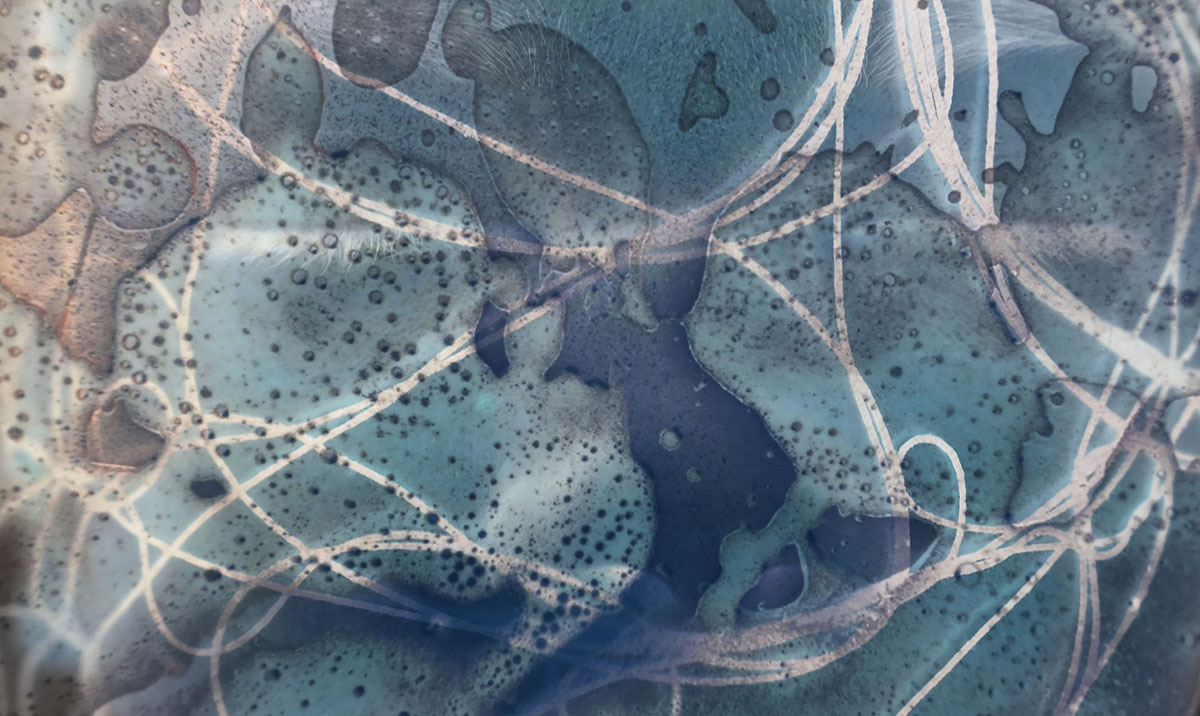
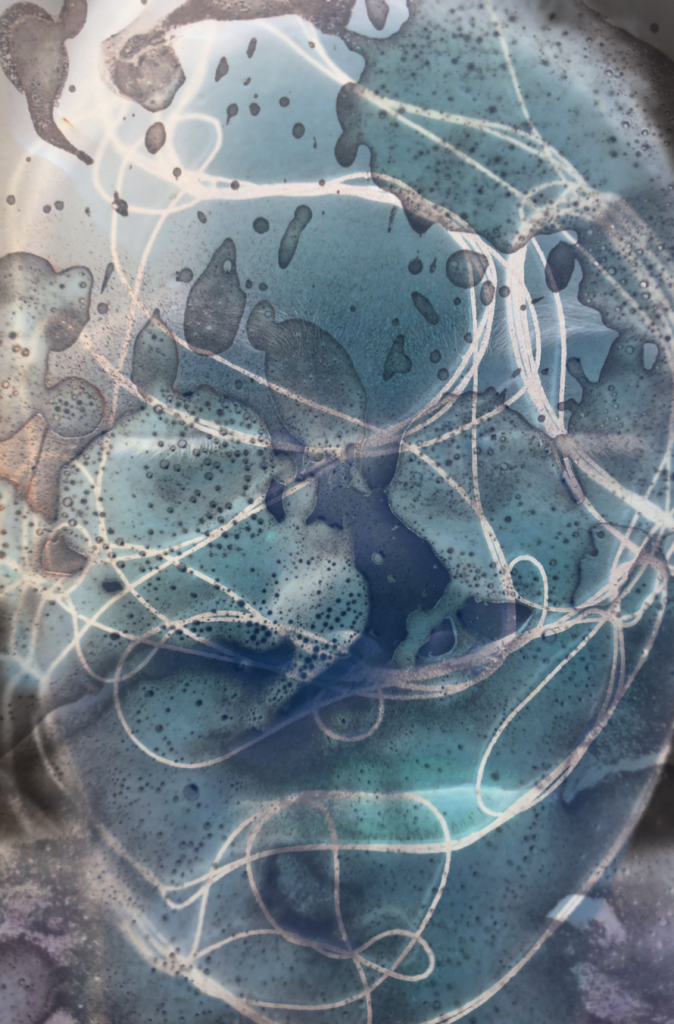
In the piece attached here, swirling shapes, liquid textures, and layered depths evoke something both physical and emotional. You might think of water, storm clouds, cosmic energy, or even internal spaces of the mind. There is movement everywhere—lines looping and drifting, dark forms growing and dissolving, light filtering through pockets of deep blue and teal. It feels like something is in constant transformation. Chaos isn’t static here; it breathes. It shifts. It pulses.
The title Cleansing matters. Cleansing is not gentle water trickling over smooth stone. It is force. It is friction. It is something that scrubs, washes away, strips down, and renews. That process can feel uncomfortable. But it is necessary. Beverlin reminds us that in the midst of rage and despair, we risk losing compassion. We risk forgetting our shared humanity. The work insists that connection still exists beneath the noise. Even when life feels fractured, we remain tied to one another, to something larger, to a shared world we must care for together.
The textures in her imagery echo that emotional complexity. Tiny bubbles suggest breath—like something underwater, suspended between drowning and floating. They could also read as cells, as living matter, as proof of existence. The fluid shapes remind us of bodies, oceans, sky, and internal landscapes. There is no single interpretation, and that openness is part of the strength. The images let viewers bring their own stories, fears, and hopes to the work. They invite reflection rather than instruction.
At the core of Beverlin’s practice is a firm belief that connection is not optional. It is essential. Isolation, division, and indifference erode what makes us human. Her work is a call to remember that everyone carries something. Everyone is trying to navigate a world that often feels overwhelming. The series acknowledges that things are broken. It does not deny the pain. But it refuses to stop there. It holds space for healing, for resilience, and for the belief that repair, while difficult, is still possible.
Living between two distinct regions also seems to reinforce that idea of dual experience. Iowa offers grounded familiarity, roots, and quiet reflection. New Mexico offers openness, horizon, and spiritual expansiveness. Beverlin’s art bridges those spaces, just as it attempts to bridge emotional distance in human life. She stands between worlds—between personal and collective feeling, between beauty and unrest, between despair and hope—and invites others to stand there with her.
Ultimately, Kodi Beverlin’s Cleansing is not just about chaos. It is about what exists inside the storm—the fragile but persistent human capacity to care, to recognize one another, and to remember that even in darkness, we belong to something shared. Her work does not promise easy answers. Instead, it offers presence, reflection, and an emotional honesty that feels deeply needed today.
