

Ken Wickenden is an artist who paints from memory, emotion, and a lifetime of lived experience. His story is not a typical tale of gallery circuits or formal academies. It is grounded in something simpler and more honest: a commitment to holding on to what matters. Wickenden’s art reflects one key truth—life is short, love is fragile, and happiness is worth defending. His work carries the weight of time, personal loss, and the steady fire of resilience.
Wickenden lives in a world shaped by reflection. The people he has loved, the moments that marked him, and the passing years have all become artistic building blocks. His practice suggests that even painful memories can become a source of strength. He paints not for applause, but to keep stories alive and visible. His art is a form of conversation, offered to whoever stands in front of it.
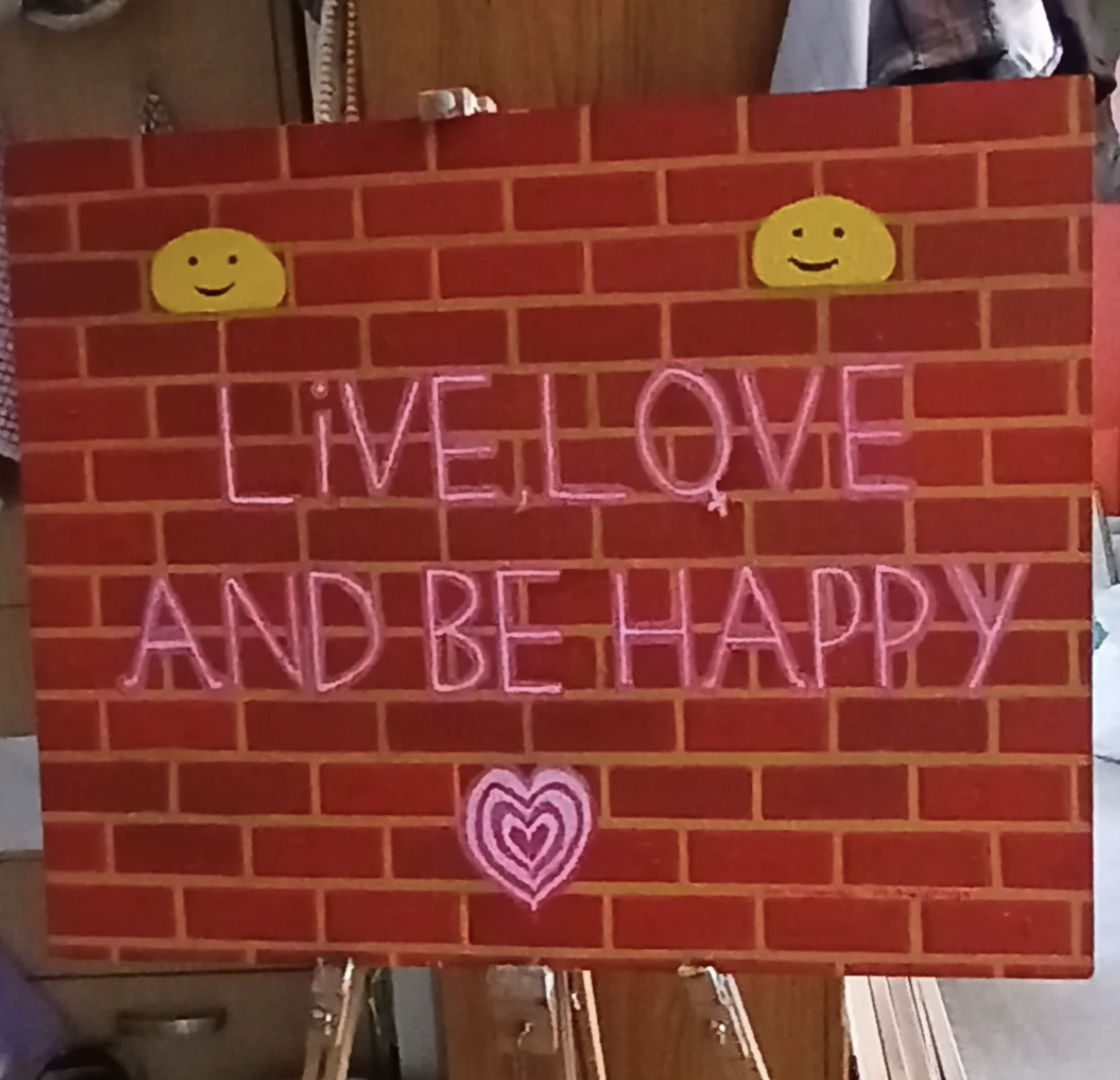
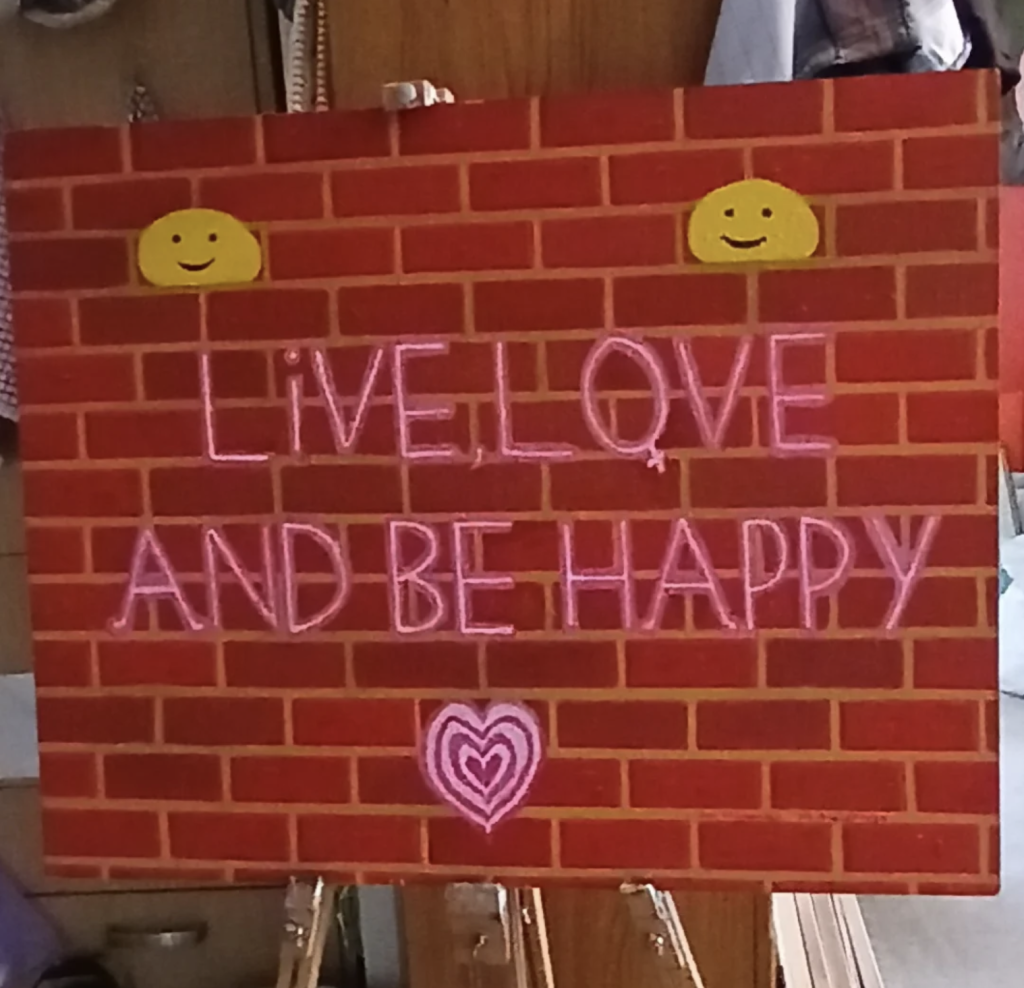
One of his most personal pieces is a painted cardboard work measuring 76 x 55 x 6 cm—a red brick wall with a message written in large neon pink lettering: “LIVE, LOVE AND BE HAPPY.” Two bright yellow smiley faces sit at the top, one on each side, almost like guardians overlooking the words. Beneath the text sits a hand-painted heart, drawn in layered, psychedelic pink rings. At first glance it looks playful and direct, but behind it sits 37 years of history and the memory of his wife, Avril Wickenden.
The work traces its origin back to 7 August 1987, when Wickenden painted the original brick wall—an actual physical wall, not just the cardboard version we see today. Avril passed away only three years later. The cardboard recreation, made decades later, stands as a tribute. It does not mourn. Instead, it celebrates. Wickenden chose not to paint sorrow or absence. He chose to paint joy, connection, and survival.
The entire artwork reads like a declaration. The brick pattern suggests stability: each brick is a day, a memory, a decision to continue forward. The pink lettering glows against the red surface like neon street art, loud and unapologetic. The smiley faces soften the mood, turning it from a memorial into something uplifting. The heart at the bottom pulls the viewer inward; it feels like a statement that love remains even after loss.
There is no hidden metaphor or complex symbolism here—Wickenden keeps his message clear. Life is not meant to be dissected into art theory. His approach feels real: a man painting what he feels, hoping the words will reach someone who needs to hear them.
The artwork triggers a simple question: why bricks? A brick wall can suggest obstacles, structure, or strength. It can also carry the idea of building something—home, family, a life. Wickenden painted his original brick wall long before he knew the loss he would face. In hindsight, it becomes symbolic. Those bricks may now represent the emotional foundation he stands on today.
The bright smiley faces bring a pop of humor and optimism. They call back to an era when the smiley icon was everywhere—button pins, posters, 80s culture. They echo Avril’s presence, maybe even her personality. They sit high on the image like the sun.
The pink heart at the bottom feels like the artwork’s anchor. It draws the viewer’s attention downward, grounding the message. The rings expand outward like ripples, hinting at how emotion spreads across a lifetime. It is a simple shape, but filled with intention.
When Wickenden talks about the piece, he doesn’t talk about technique. He talks about the date, the timeline, and his wife. He remembers painting the wall in 1987, unaware of what lay ahead. Now, 37 years later, he stands on the other side of that history, looking back with love and gratitude rather than despair. This perspective changes how one reads the artwork. The message—“LIVE, LOVE AND BE HAPPY”—is not cliché here. It is earned.
Wickenden’s work feels like a public message written in private handwriting. It is handmade, human, and unpolished. The cardboard material reinforces that feeling. It is not a marble monument or a bronze sculpture. It is something ordinary turned meaningful. That ordinariness gives it strength. Anyone could make a piece like this, but almost no one does. Most people do not take the time to write a message to themselves about happiness. Wickenden did.
The tone of the artwork is generous. It does not instruct people how to live; it simply offers a reminder. Beneath the bright colors, there is a quiet acknowledgment that choosing happiness is hard. It requires determination. It requires remembering the people who shaped us.
Wickenden paints because memories matter. His art exists at the edge between past and present. The tribute to Avril is not expressed with mourning imagery. Instead, it reflects joy and a simple truth: the love they shared still shapes his life.
This small cardboard wall becomes a symbolic structure where loss meets gratitude. His message asks viewers to protect the things that remain good. To keep loving even after heartbreak. To stay alive in spirit, not just in body.
Ken Wickenden reminds us that art does not need grand galleries or complex theories to matter. Sometimes, all it needs is honesty, memory, and a sentence written in bright pink paint:
Live.
Love.
And be happy.
